'pay per click search engines' Archive

Improve your rankings, traffic, and profits today. The SEO Book training program offers you:

  • Over 100 training modules, covering topics like: keyword research, link building, site architecture, website monetization, pay per click ads, tracking results, and more.
  • An exclusive interactive community forum
  • Members only videos and tools
  • Additional bonuses - like data spreadsheets, and money saving tips
  • Every order comes risk free, and with the best selling SEO Book as a free bonus

Watch this video to learn more.

Improve your rankings today!

Jul
31

I recently had an email chat with Alden DoRosario from Chitika about the recent rapid growth of their ad network. They have been aggressively signing up bloggers and other independent publishers, and are now getting over 2 billion monthly impressions, with their behaviorally targeted Premium ads getting hundreds of millions of monthly search driven impressions, putting their search distribution network on par with Ask.com.

How their premium ad network works is they target the ads to be relevant to search query that sent traffic to the publisher's site, thus even if the ads are not shown on a search page they still are seen by searchers right after they search and click through to the site.

Alden gave me a link for a $75 bonus code for any publisher that makes $75 in commissions before the end of October. Publishers are paid 60% of the ad click value, with the house getting 40%. I just added their ads to my mom's weight loss blog. It looks like their ad network is not quite as deep as Google's but they do well for higher volume search queries.

Most search engines are a backbone for an ad network, but it is hard to build query volume for a new search engine. Just look at how few people have used Wikia Search in spite of endless hype. Wikia Search got a couple million lifetime searches whereas Chitika gets billions of monthly ad impressions.

Most people do not feel they have a search problem, but many publishers feel their content could be monetized better. If you didn't have huge search distribution how would you create a search ad network? If an ad network grows big enough do you think they could do it the other way around, using their ad network distribution as a backbone to start a search engine?

Disclaimer: The free $75 bonus is an affiliate link, but when I chatted with Chitika I pushed hard to get publishers the best payout bonus and longest payout bonus period possible rather than focusing on trying to maximize my commissions.

Subscribe to our blog via email or RSS to get more great posts like this one.

Jun
15

I created a new training module talking about how language in new industries changes over time, how you can track change, and how you can take advantage of structural changes. I made the first 1/3 of it freely available, but the action items are for subscribers only.

I am still trying to figure out how to balance creating premium members only content and publish many posts to the blog. Which of the following ideas do you like best?

  • make one out of every few freely available forever
  • make a portion freely available forever
  • make new content freely available in its entirety and then make it exclusive after a week or some other period of time

Subscribe to our blog via email or RSS to get more great posts like this one.

Jun
12

The WSJ reported that Google and Yahoo! have inked a non-exclusive ad deal

Yahoo said it will display some ads sold by Google in an agreement estimated to generate $800 million in annual revenue. In the first 12 months following implementation, Yahoo expects the deal to generate an estimated $250 million to $450 million in incremental operating cash flow.

Both companies have agreed to "delay implementing the deal for up to three and a half months while regulators review it." The deal can be terminated at any point in time, but if it is terminated within 24 months Yahoo! will owe Google $250 million.

The partnership is only for the US and Canadian markets, but expands beyond Yahoo!'s search results into Yahoo! content ads and even the syndicated Yahoo! Publisher Network. Given Yahoo!'s poor ad relevancy and that they are reselling Google ads, how will the Yahoo! Publisher Network ever gain marketshare from AdSense?

Beyond the incremental revenue stream, this also gives Google another opportunity to spy on web users who use their largest competitor - allowing Google to get a better view of the average web user and making it easier for Google to clone and beat Yahoo! in any market where Yahoo! leads.

Here is Google's take, and the full Yahoo! press release is below

Yahoo! to Strengthen Competitive Position in Online Advertising Through Non-Exclusive Agreement With Google
Thursday June 12, 6:16 pm ET

Agreement Advances Yahoo!'s Open Strategy; Enhances Ability to Compete in Converging Search and Display Marketplace

SUNNYVALE, Calif.--(BUSINESS WIRE)--Yahoo! Inc. (Nasdaq:YHOO), a leading global Internet company, announced today that it has reached an agreement with Google Inc. that will enhance its ability to compete in the converging search and display marketplace, advancing the company’s open strategy. The agreement enables Yahoo! to run ads supplied by Google alongside Yahoo!’s search results and on some of its web properties in the United States and Canada. The agreement is non-exclusive, giving Yahoo! the ability to display paid search results from Google, other third parties, and Yahoo!’s own Panama marketplace.

Under the terms of the agreement, Yahoo! will select the search term queries for which – and the pages on which – Yahoo! may offer Google paid search results. Yahoo! will define its users’ experience and will determine the number and placement of the results provided by Google and the mix of paid results provided by Panama, Google or other providers. The agreement applies to paid search and content match and does not apply to algorithmic search. The agreement also applies to current partners in Yahoo’s publisher network.

Yahoo! CEO and co-founder Jerry Yang said, “We believe that the convergence of search and display is the next major development in the evolution of the rapidly changing online advertising industry. Our strategies are specifically designed to capitalize on this convergence -- and this agreement helps us move them forward in a significant way. It also represents an important next step in our open strategy, building on the progress we have already made in advancing a more open marketplace.”

“This agreement provides a source of funds to both deliver financial value to stockholders from search monetization and to invest in our broader strategy to transform display advertising and advance our starting point objectives with users,” said Yahoo! President Sue Decker. “It enhances competition by promoting our ability to compete in the marketplace where we are especially well positioned: in the convergence of search and display.”

Agreement Provides Attractive Economics and Enhances Search Monetization

Yahoo! believes that this agreement will enable the Company to better monetize Yahoo!’s search inventory in the United States and Canada. At current monetization rates, this is an approximately $800 million annual revenue opportunity. In the first 12 months following implementation, Yahoo! expects the agreement to generate an estimated $250 million to $450 million in incremental operating cash flow.

The agreement will enhance Yahoo!’s ability to achieve its goal to grow operating cash flow significantly, while at the same time providing flexibility to continue to invest in ongoing initiatives such as algorithmic search innovation and search and display advertising platforms. It gives Yahoo! complete flexibility to continue to use its Panama paid search results.

Significant Benefits Will Flow to Users, Advertisers, Publishers and Employees

Users will also benefit from Yahoo!’s ability to invest incremental operating cash flow in ongoing improvements to its search services, building upon recent major innovations such as Search Assist and SearchMonkey. Advertisers will continue to benefit from multiple marketplace alternatives including Panama, Google and others. Publishers will benefit from a winning combination of distribution, monetization and services to help them grow their businesses. The financial benefits will enable Yahoo! to broaden the scope of its investments and initiatives, enhancing Yahoo!’s ability to offer attractive career opportunities to its employees.

Terms of the Agreement

The agreement will enable Yahoo! to run ads supplied by Google's AdSense™ for Search and AdSense™ for Content services next to Yahoo!’s internally generated paid search and algorithmic search results. Yahoo may also run Google-supplied ads on non-search Yahoo web properties, as well as on current members of its partner network. The agreement has a term of up to ten years: a four-year initial term and two, three-year renewals at Yahoo!’s option. It applies to Yahoo!’s operations in the U.S. and Canada only. Advertisers will continue to pay Yahoo! directly for clicks served by Yahoo! from Yahoo!’s Panama and Content Match marketplaces. Advertisers will pay Google directly for each click on Google paid search results appearing on Yahoo! owned and operated network or certain affiliate sites. Google will share a percentage of such revenue with Yahoo!.

In addition, Yahoo! and Google agreed to enable interoperability between their respective instant messaging services, bringing easier and broader communication to users.

The agreement allows either party to terminate the agreement in the event of a change in control of either party. The agreement also requires Yahoo! to pay a termination fee if the agreement is terminated as a result of a change in control that occurs within 24 months. The termination fee is $250 million, subject to reduction by 50 percent of revenues earned by Google under the agreement.

Although Google and Yahoo! are not required to receive regulatory approval of the deal before implementing it, the companies have voluntarily agreed to delay implementation for up to three and a half months while the U.S. Department of Justice reviews the arrangement.

Goldman, Sachs & Co., Lehman Brothers and Moelis & Company are acting as financial advisors to Yahoo!. Skadden, Arps, Slate, Meagher & Flom LLP is acting as legal advisor to Yahoo!, and Munger Tolles & Olson LLP is acting as counsel to the outside directors of Yahoo!.

Yahoo! will host a conference call to discuss the agreement with Google at 6:30 p.m. Eastern Time today. To listen to the call live, please dial 877-391-6847 (reservation number 70308474#). A live audiocast of the conference call can be accessed through the Company's Investor Relations website at http://yhoo.client.shareholder.com/index.cfm. In addition, an archive of the audiocast can be accessed through the same link. An audio replay of the call will be available following the conference call by calling 888-286-8010 (reservation number 84138579).

Subscribe to our blog via email or RSS to get more great posts like this one.

Feb
25

AdWords has become a black box beyond the means of many small advertisers. To help some advertisers automate their accounts tools like free conversion tracking and CPA based bidding have came about. But all the tools that help enhance the perceived value of search ads and the value of conversions does nothing for brand ads or the other ads people see before searching and buying.
Content ads, which were relatively expensive when AdSense first came out, have seen their price drop over the years as

  • advertisers adjusted content bids downward
  • smart pricing reduces prices (again, again, and again)
  • quality scores that drives out arbitrage ads
  • the clickable region has got smaller

The value of many publishing based business models has aggressively eroded as

  • publishing markets get saturated
  • AdSense has replaced direct ad sales for many sites
  • Google keeps discounting the price (and perceived value) of non-search ads
  • Google's search based ads get conversion credit for demand created by other ads

Google claims their success is just because they are simply better than the competition and they have been doing search longer (that second claim is untrue - Yahoo! owns Inktomi and AltaVista, which have both been doing search longer than Google). The truth is they have a huge advantage in network effects, have advertising believe that their inventory is worth more than it is, and that other online ads are worth less than they are. It is going to be hard to create a viable competitor unless the metrics for measuring value are changed.

Microsoft's answer to this is called Engagement Mapping, yet another black box, but one that aims to share part of the ad credit with display ads (clicked or not) instead of tying most of the ad value to the search based conversion. Publishers would clearly benefit from this, but if it is hard to get advertisers to buy AdSense ads on Google (where Google essentially giving away the ads) how hard will it be to get advertisers to buy in on this? Perhaps big brands will use it, but smaller companies will not be interested.

If Microsoft does not own a big piece of the search market, another big hurdle is how will they advertisers trust this model without giving Microsoft their analytics data?

How might this pricing model change online publishing (for better or worse)?

Subscribe to our blog via email or RSS to get more great posts like this one.

Feb
23

I recently bought a few AdWords ads for Microsoft adCenter's affiliate program. These links were direct affiliate links that headed directly to Microsoft - the searcher never touched my site.

Compare the following 3 AdWords ad campaigns

The first campaign is a strategic one, where I do not mind losing money if it increases usage, which may lead to more links (and better organic rankings) over time. But that second campaign, with a similar number of clicks, never even touches my site and still has a baseline conversion rate and conversion cost similar to the strategic ad group.

Truth be told those conversion sample sizes are so small that it is hard to draw concrete evidence from them, but if I was telling myself that some of the ad sales caused by that strategic ad campaign help subsidize at least some of the cost, then I might be operating under a false pretense. Some of those conversions may have happened anyway.

That third ad campaign consists largely of brand related keywords and a few other somewhat related terms. Notice how the conversion rate is higher. Microsoft recently published research that brand related search terms tend to convert better than twice as well as non-brand terms.

Why is this important? As Google controls an increasing large piece of the online advertiser pie, if you use their analytics, many of those conversions THEY track are falsely tied to their ads. They would have happened even if you were not buying AdWords ads. As far as brand related conversions go, conversions tied to brand phrases typically are not incremental, which means those would have happened even if you were not buying AdWords ads.

You can use direct conversions as a proxy for the value of advertisements, but if you have a large ad campaign and a well known brand, you are likely buying brand exposure more than direct conversions, even if you control your spend on using a CPA metric.

Subscribe to our blog via email or RSS to get more great posts like this one.

Feb
17

Laziness is Beyond Your Control

Everyone, at least on some levels, is lazy. I work my ass off, but am still lazy about doing things I do not enjoy doing. If my wife asks me to wash the dishes the hand of God strikes upon me a mean streak of laziness. It is outside my control, I swear ;)
Right now I am trying to write a sales letter, which has made me lazy, and instead made me want to write this post.

Laziness Leads to Productivity Gains

I don't like having to think some things through too much if they can be automated. And so tools like keyword list generators are made.

I recently found a sweet affiliate program in a field where no other affiliates existed. For the right keywords, click value was about $12 a click, and I was paying like 60 cents a click. With under an hour of work, I made hundreds of dollars in daily profit with virtually no effort.

Find Something You Love And Make it Your Own

I just logged in today and saw that my conversion stats dropped to virtually nothing over the past couple days. Odd. So then I searched, and like 10 affiliates (or, more likely, 1 competing affiliate 10 times) launched ads showing for many of the keywords I bid on, with many of them stealing my exact ad copy - word for word.

Slimming Profit Margins

Bidding Wars Reduce Profits

So what is the solution? Maybe I increase my bids again. But then they will increase their bids again. A bigger and bigger piece of the profits get shipped to Google, while these clowns and I eventually compete for crumbs. One of the reasons Google does not care if others steal your ad copy (or all the content on your website) is because at the end of the day they know it erodes the value of copyright and creates a bidding war that deposits more money in their bank account.

Quick Paydays

PPC affiliate marketing and arbitrage works that way, where you find a payday, hold it for a few weeks or a few months, then someone competes and the profit margins drop, unless you have a higher visitor value it keeps costing you more time to make less, until the opportunity cost exceeds your profit potential, and then you are off hunting for the next big idea. Competitive forces make it hard for this strategy to build long-term value unless you are operating in a small market or are using a technique that is pretty dirty.

Super Affiliate Secrets

One of my friend that was doing well with PPC affiliate stuff got up to about $1,000 a day of profit for an affiliate network. He ran it for about a year, then his affiliate network decided that they would find something they love and make it their own.

If you don't own the supply chain or have a distribution chain that is hard to replicate your competitors consist of

  • other affiliates
  • the search engines
  • quality scores and algorithmic changes
  • the companies you affiliate with
  • anyone else interested in the keyword you are buying

SEO Loves Your Profit Margins

This is why I like SEO so much more than PPC. Most people are too lazy to spend years researching their topic, years building a brand, years building links, and years building social and customer relationships. We are afraid of failure, afraid of success, and afraid that we are investing too much in one place. But, if someone sees me ranking in the organic results they can't just clone it unless they know SEO well, and are committed for the long haul. In many cases, knowing SEO well means having capital, time, passion, and a lot of marketing knowledge.

Emotionally Engaged Brand Evangelists

Off the top of your head, how many people or brands in the SEO space can you think of? How many give you some sort of emotional response? How many helped you change your life for the better? Even in some of the most competitive and most saturated marketplaces there is not much real competition.

Thanks for the Laziness, PPC Affiliate Dude!

SEO separates out real businesses from 95% of the people buying PPC ads. The guy stealing ad copy is too lazy to compete at that level. I'll enjoy the logarithmic growth in profits (which have been at least doubling every year) while he keeps stealing table-scraps from Google and other affiliates until his accounts get banned.

Find Something You Love And Make it Your Own!

Subscribe to our blog via email or RSS to get more great posts like this one.

Jan
30

I put a Microsoft AdCenter affiliate ad in the sidebar of the blog.
I generally do not like putting too many ads on this site, but...
  • their traffic converts well because it is such a clean source (no dirty clickfarm syndication partners)
  • I recently fell in love with Microsoft's Ad Intelligence tool. If you have not tried it yet I urge you to try it. This post and this video offer a review of some of the features
  • $50 in free clicks is a great offer for search marketers who have yet to try Microsoft's ad platform
  • I think the web is healthier if Google has some competition, and Yahoo no longer attempts to compete

Are you against affiliate ads? Have you tried AdCenter or the Ad Intelligence tool yet?

Subscribe to our blog via email or RSS to get more great posts like this one.

Jan
16

To be honest, I have used the "scam or not" angle before when trying to pull in traffic for something and have called stuff a "scam" when I did not like it, but I have never called something a scam right before trying to sell it.

Is this a common affiliate technique? Would you allow it? Does it bring in skeptics that never would have bought? Or does it taint the brand too much?

Subscribe to our blog via email or RSS to get more great posts like this one.

Jan
11

Ad Intelligence is a new cutting edge keyword tool from Microsoft which will probably force Google and Yahoo to make better keyword tools. All of this data is free during the beta test as long as you have a Microsoft AdCenter account (you can set one up for $5, and get free ad money using the below coupon) and a copy of Microsoft Excel 2007 (the Ad Intelligence link below allows you to download a free trial of Excel).

Get Started Today

Step 1: Create Your Microsoft AdCenter Account

Use the following AdCenter promotion code. Sign up today and get $75 in free clicks at Microsoft AdCenter. Try Microsoft adCenter for free* with a $75 credit for paid search clicks.

Step 2: Download Excel Trial & Ad Intelligence Plug-in

Download and install both here.

Example Keyword Data

Some samples of the kinds of data you can get from Microsoft Ad Intelligence:

keyword ad data

related keywords to advertise on

spiky keywords (recently hot search volume)

URL related keywords (site related key words)

Background Data Information Reviewed

Here are some of the sweet features of Microsoft Ad Intelligence:

  • Keyword wizard: Allows you to extract keywords based on a list of keyword in excel, a given vertical, or a given URL. Then it allows you to generate an expanded keyword list based on category similarity, keyword bidding association, or keywords containing the core keyword. Then it allows you to export an output of estimated search volume, clicks, ad position, ad CTR, and click cost for a given date range and match type.
  • keyword extraction: Extract keywords based on an input URL. Can set maximum keywords from 1 to 100, and can set a minimum confidence level of relevancy.
  • keyword suggestion: suggest keywords based on aggregate advertiser behavior, keywords containing the core keyword, or keywords that are deemed to be similar based on category similarity
  • search buzz: Top category keywords based on 22 core categories and about a couple hundred subcategories. The spiky tool uses the same categories but is focused on spiky keywords, and includes spiky index, spike start date, and spike end date. You can also set it to "all verticals" to discover leading overall spiky keywords or leading common search queries.
  • monthly traffic: Monthly search volumes for keywords, and forecasts for the next 3 months. Also offers a daily search volume option.
  • keyword categorization: Identifies categories that a keyword belongs to.
  • geographic: Shows the geographic breakdown of a search query.
  • demographic: Shows date range and male vs female breakdown stats of keywords.
  • monetization: Allows you to view ad impressions, ad clicks, CTR, and CPC by category.
  • advanced algorithms: Allows you to change date ranges and other variables for the above tools.

Try it Today

Step 1: Create Your Microsoft Ad Center Advertiser Account

Open your account using the linked to Microsoft AdCenter coupon / promo code. Try Microsoft adCenter for free* with a $75 credit for paid search clicks.

Step 2: Download Excel Trial & Ad Intelligence Plugin

Download and install both here.

Subscribe to our blog via email or RSS to get more great posts like this one.

Jan
09

DaveN, well known for SEO, published stats about how PPC ads aided organic conversions. Andrew Goodman's firm, well known to focus on paid search, now does SEO too. It seems the PPC vs SEO debate has been quiet for a year or more. Hopefully this puts a fork in it.

Subscribe to our blog via email or RSS to get more great posts like this one.

May
22

Two chocolate companies advertised similar products via pay per click ads. One wasted thousands of dollars while the other grew their business.

Subscribe to our blog via email or RSS to get more great posts like this one.

Feb
26

Jen noticed that Google's Kim Malone announced that in the next couple months AdWords will start displaying content targeted ad locations.

Google AdSense pays most publishers crumbs for their ad space. People who are running AdSense ads are willing to sell ads. And sites that have AdSense ads on them are probably actively managed.

Is there a better way to get a list of relevant pages to acquire links from than to run a content targeted AdSense ad campaign and ping those webmasters?

Subscribe to our blog via email or RSS to get more great posts like this one.

Jan
24

I got my invite to beta test Clickriver today. Yippie. I already set up my account, so lets see how long it takes Amazon to start showing my ads for things like my name and search engine optimization.

Subscribe to our blog via email or RSS to get more great posts like this one.

Dec
02

SEO Question: I was thinking about buying Google AdWords and AdSense ads or placing AdSense on my site. Will doing any of these increase my link count, Google rankings, or rankings in other search engines?

Subscribe to our blog via email or RSS to get more great posts like this one.

Nov
30

Why are companies that do not currently carry the Nintendo Wii or Sony Playstation 3 bidding on those terms to send customers to pages that do not have the product? Why is it that their landing pages do not offer the option to sign up for priority notification when they become available? How many 10's or 100's of thousands of dollars are these people wasting?

People are getting shot waiting for Playstation 3 systems, and then you have these huge retailers bidding on the associated keywords to throw the traffic away and remind potential customers that they are sold out of the product. Sorta bizzare at both ends, eh?

Subscribe to our blog via email or RSS to get more great posts like this one.

Nov
22

I just found this great offer for search advertisers. Well worth a look if you are trying to get traffic to your website. Here is a free $200 Microsoft Ad Center promotional code.

Subscribe to our blog via email or RSS to get more great posts like this one.

Oct
26

Not sure how much it is for, but Google is giving out more free AdWords coupons.

Update: Barry says the AdWords coupons are $50 each, but unfortunately they are expired now. All is not lost though!

Subscribe to our blog via email or RSS to get more great posts like this one.

Oct
18

Yahoo! announced they are launching their new Panama platform. In response, Google quietly announced they are launching a free multivariable testing program which ties in with AdWords.

Subscribe to our blog via email or RSS to get more great posts like this one.

Oct
14

Yahoo! tends to be a bit more cautious than Google when it comes to allowing trademark related ads. That significantly suppresses their earnings because brand related search queries are often some of the most targeted, most commercial, highest converting, and most expensive keywords.

Subscribe to our blog via email or RSS to get more great posts like this one.

Jul
16

Google AdWords updated their landing page quality scoring algorithm. I have got quite a bit of email on the issue, although people are still working through what all Google is doing.

In much the same way to how Google has clearly stated their hatred for low quality affiliate sites in the organic SERPs some of that pure hate is crossing over into their AdWords relevancy algorithms, where they are looking at the landing page quality (and other factors) and squeezing the margins on many business models.

Subscribe to our blog via email or RSS to get more great posts like this one.

May
08

SER recently mentioned Microsoft AdCenter dynamic text.

Microsoft AdCenter dynamic text is similar to Google's AdWords Dynamic Keyword Insertion, but also allows you to set other variable ad copy driven off the keyword inclusion. For example:

Keyword / Dynamic text parameters
"sedans" / 5% off
"SUVs" / 7% off

When you are ready to build your ad, you will enter "All {keyword} {param2} as the ad title. When a user queries "sedans," the ad that appears will be "All sedans 5% off."

Microsoft's dynamic text also allows you to use {param1} to drive your ad URL and / or landing page.

AdCenter FAQs here.

Subscribe to our blog via email or RSS to get more great posts like this one.

It looks like Yahoo! was waiting for MSN to dump them before rolling out their new PPC product. MSN dumped them last week, and today Yahoo! is already launching their shiny new PPC system.

The new system is going to be rolled out in stages. This stage is mostly about improving the underlying data and analytics platform. On the 17th of May they intend to announce the new PPC relevancy algorithm. In the third quarter they also plan on integrating analytics that will allow you to buy and track ads on Google or MSN as well.

More news and likely a bit of discussion at TW.

Subscribe to our blog via email or RSS to get more great posts like this one.

May
04

Via WMW comes news that MSN has completely dumped Yahoo! as a PPC provider and anyone can now sign up for Microsoft AdCenter.

MSN has little traffic compared to Google or Yahoo!, but has more controls than other top PPC providers. While their service is new their traffic should be cheaper than buying similar traffic from Yahoo! or Google.

Subscribe to our blog via email or RSS to get more great posts like this one.

Apr
28

Recently someone published a funny rant video about Google AdWords arbitrage. Google began killing off that market last July, when they started quality based minimum bids. Today Google furthered that mission, by announcing they will be showing less broad matched AdWords ads on queries they deem to be informational.

Their initial post was clear as mud, but Danny got some clarification.

With Google opening up their keyword tool and offering their search suggest service on the toolbar while killing off some of the underpriced informational query inventory many commercial terms will grow more competitive.

They are trying to keep ads as relevant as possible to prevent AdWords ad blindness.

Subscribe to our blog via email or RSS to get more great posts like this one.

Apr
06

Sometimes you do not even need to test a pay per click search engine to know there isn't much value there. In much the same way you can determine the quality of a directory by the sites listed there, you can also determine the (lack of) value of a PPC engine by looking at the sites listed there.

Check out these LookSmart ads:

And then look at this search result:

  • they throw tribal fusion pop up ads at site visitors.

  • they sell off target banner ads at the top of the search results.
  • they don't even have good ad placement on their own site, putting dumb banners and pop up ads front and center - making users hunt for the ads.
  • what is up with the dumb blue triangle on the left? It points at nothing.

If they sell trashy off topic ads front and center on their own site what does that do for advertiser or publisher trust in their ad network?

Dumb. Really.

They couldn't even keep Zeal, their free volunteer directory, running with their own ads OR Google's ads (due largely to ignorant ad placement / integration).

They may be able to leverage all of their content to make some sort of a content play, but they would probably gain more credibility if they stopped selling ads directly and / or got rid of pop ups and integrated the ads appropriately into their search results (ie: place off topic banners AFTER the relevant ads).

And they probably would do better in other engines if they cleaned up their URLs and page titles a bit. They probably cut off 50% to 75% of their traffic with their current URLs, page titles, spreading their content over many domains with poor internal link structure, and marking it hard to get back to the root site from some of the sub sites.

Combine that with making their own ad market less efficient due to poor ad placement of the relevant ads and scaring off visitors with pop ups and you can see how the margin based network business they are running is doing less than stellar.

It might be different if they didn't also own a search engine, but how can they be so not clued up?

Subscribe to our blog via email or RSS to get more great posts like this one.

Feb
23

Danny points at a SEW thread noting that starting next month Yahoo! will no longer allow competing businesses to bid on trademark phrases:

"On March 1, 2006, Yahoo! Search Marketing will modify its editorial guidelines regarding the use of keywords containing trademarks. Previously, we allowed competitive advertising by allowing advertisers to bid on third-party trademarks if those advertisers offered detailed comparative information about the trademark owner's products or services in comparison to the competitive products and services that were offered or promoted on the advertiser's site.

In order to more easily deliver quality user experiences when users search on terms that are trademarks, Yahoo! Search Marketing has determined that we will no longer allow bidding on keywords containing competitor trademarks."

Trademark terms are some of the most valuable words in the search space. While this move may not be surprising given Yahoo!'s past activities, will this move cause other engines to change their policies? How will this policy effect comparison sites which offer many brands on the landing page? Is Yahoo! trying to commoditize the search marketplace to help them make more money away from search?

They still support typosquatting and cracking sites away from search, but may that be coming to an end too? The recent Perfect 10 vs Google lawsuit points to newtwork quality becoming a more important issue.

Subscribe to our blog via email or RSS to get more great posts like this one.

Dec
22

Rand reports on OR being an ignored as an ad targeting word in Google AdWords.

Pretty bad deal for those using their keyword selection for regional Oregon AdWords campaigns.

I don't do as many power searches as I should, but today I noticed that when I searched for "blah" or "fla" Google ignored the boolean function until I capitalized the term. Can't they trust that a capitalized OR stands for something in the ads too?

I think Rand's post about OR is a good example of how just being around and experiencing SEO or SEM teaches you many tricks, problems and ideas that most would not naturally think of before playing around in the field.

Perhaps if Oregon becomes part of Baja Canada Google will not have to worry about this problem. If CA and WA stop working as intended then we will know Google is trying to send a hint, and adjust our ads to target Baja CA.

Google has been involved in political redistricting in the past.

Subscribe to our blog via email or RSS to get more great posts like this one.

Nov
25

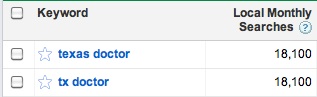
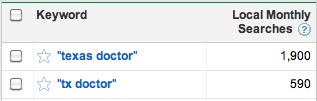
In How to Become the Doctor for a Famous Rock Band Clifton Sewell tells the whole world (including his competitors) that AdWords are currently under priced in his vertical.

The doctors have been running paid ads on Google for four months now, under terms such as "San Francisco Doctor". They're spending roughly 50 cents per click for top positions and their total monthly spend is about $500. "We get about 20-30 new patients a month from it, so we're happy," said Clifton.

Next month part 2 of the series will be out, where Clifton bitches about how AdWords is ineffective due to being hyper competitive.

Subscribe to our blog via email or RSS to get more great posts like this one.

Nov
16

I have not been able to get a screenshot, but at WMW Vegas I noticed that when Baked Jaked was looking at Google search results for [Gwen Stefani Tickets] that their were Google AdWords ads at the top, right, and bottom.

Subscribe to our blog via email or RSS to get more great posts like this one.

Oct
05

This search showed one of the longer AdWords creatives.

I refreshed the Google search 3 times and saw that ad live as well on the third go.

Already 3 ads at the top sometimes, and now longer ad copy tested in some of the other ad slots. Initial thoughts:

  • those really don't fit on the sidebar. Maybe at the top, but they look screwy on the right 14% of the screen.

  • got to imagine those hog the CTR from the ads around them for sticking out so much

noticed at SearchGuild

Subscribe to our blog via email or RSS to get more great posts like this one.

Aug
18

AdWords Quality Based Minimum Bids:
have gone into effect. useful for those generic terms or low volume terms that used to get arbitrarily disabled, as well as terms that were slightly unprofitable at 5 cents a click.

AdSense:
has a new blog (from JenSense)

They also are beta testing allowing publishers to define user profiles for ad targeting.

PPC Trademark Law:
US courts say it is fine to use a trademark term to trigger ads, but not OK to use trademark terms in ad copy.

Miva vs Yahoo!:
patent dispute solved for $8 million, which is far cheaper than what Google paid, although Miva is forced to give Yahoo! an undisclused cut in future earnings as well.

Yahoo! Search Marketing:

Subscribe to our blog via email or RSS to get more great posts like this one.

Aug
05

Pay Per Click:

  • Google beta testing longer AdWords ad descriptions (up to 200 characters).

  • MSN to ramp up beta testing of MSN Keywords. Their ad copy specs will match Google's original 25 characters in the title & 70 characters in the description.
  • apply to beta test Yahoo!'s publisher ads
  • Ask Jeeves recently said they will show less pay per click ads. (Although they have also reported this in the past.)

We the United Spammers of Engines:
stuntdubl offers reinclusion request tips

Why the Desktop is So Important:
targeted marketing - Yahoo! sending email marketing based on data returned from the Yahoo! Toolbar.
Mozilla Corporation getting donation love from Google

Internet Stocks are Hot:
Baidu raises IPO price:

Baidu.com sold 4.04 million shares at $27 each, according to a person familiar with the transaction. The price was higher than the $23 to $25 range the Beijing-based company outlined in an Aug. 3 filing with U.S. regulators.

Amazon and eBay have both rose sharply recently.

The Sound of Search:
Yahoo! announced their audio search

Subscribe to our blog via email or RSS to get more great posts like this one.

Jul
28

Much of this post was stolen from NickW ;)

SEO Book Review:
NickW reviews SEO Book. That is about the most thoughtful review I have seen of any book or software or anything like that in a long time. Thanks for the killer review and suggestions Nick!

Danny Sullivan:
Now has a show on Webmaster Radio and posts daily archives on Search Engine Watch.

Fairly interesting to see that in the last year and a half Search Engine Watch changed from a site that was primarily driven by articles and email newsletters to a site that also has a forum, a blog, and a daily podcast.

It is easy to get stuck with a format because it is easy to do what worked in the past, but the fact that Danny's publishing mechanisms evolve so much should be a reminder to those in strong market positions afraid of changing formats. GrayWolf suggested that I make ebook updates available via RSS and others have asked why I have not made a printed version yet.

Ask Jeeves PPC:
Ask Jeeves to sell their top 3 ad positions internally, if they will make more cash from them than selling Google AdWords ads (factoring in both CPC and clickthrough rate). They will also syndicate these ads onto other sites including Dogpile, Search.com, and Search123.

Surely some of the quicker selling ads will be travel related ones, since IAC has a ton of potential selling ad space across it's various properties including Expedia, Hotels.com, and the like.

Widgets:
Yahoo! owns the market.

With search being so profitable you can bet that niche companies which create products that make it easy to access data or may drive traffic are going to be bought up quickly and have their products given away.

Subscribe to our blog via email or RSS to get more great posts like this one.

Jul
18

Smaller search networks can not compete with the big boys in building advertisers, users, and monetizing traffic. Hence they have to rely on gimicks and low quality publishing partners to get any exposure.

Joe Holcomb, a former executive at BlowSearch, was recently canned:

The “official” reason for my termination from BlowSearch was “Company Financial Crisis / Downsizing”.

He did a bunch to try to pump up the issue of click fraud and promote BlowSearch as a nearly fraud free network, but most of that was just marketing spin. They were using white label MyGeek services:

How was this a gimmick? Well, I used two of the services in the MyGeek back end and promoted it as a partial solution to click fraud. The manual IP blocking became “Competitor IP Blocking” and the publisher selection page became the “Traffic Source Selection” system. This all served to help the advertiser to achieve better ROI and really answered two of the biggest problems the search engine industry has been harping on (me included) for a long time now. Giving the advertiser the ability to choose and protect their ad investment.

Of course Joe just got a bad deal, and thus is going to have reason to paint a negative picture, but traffic tends to consolidate (just look at the share price of Google vs Miva) and the only way to break into a hyper competitive market is to create something uniquely innovative:

There was a post over at sew recently, some guy whining that he was getting beat silly in the serps by some old established sites. He was whining that they were doing x and so was he, they were doing y and so was he, they were doing z and so was he.

He didn't have the right attitude to succeed on the web. When you go up against those big established sites you really have to be committed and go the extra mile. If you want to world champion you have to fight the best in their own back yard, its no use being as good or even a little better, you have to knock them spark out to get the decision. - NFFC

No matter how you spin it, BlowSearch was not some amazingly new blow your hair back website. Heck they were spinning up something that was nothing more than a white label feed.

You can fake people for a bit, but eventually your source shows.

Joe also talked about his Click Defender idea, which the company never apparently believed in as much as he did. A while ago I called him out on the ClickDefender.com domain content being a joke, and apparently the owners of BlowSearch thought the same.

Interesting to see another blogger blog that they lost their job. I certainly noticed some of the marketing spin he created to help boost BlowSearch, and althoug I doubt they have much mindshare it will be interesting to see how quickly BlowSearch loses it.

From my short experience crossing with Joe online he at least seems like a good marketer, and someone should want to hire him for that. Best of luck Joe.

Subscribe to our blog via email or RSS to get more great posts like this one.

Jul
14

Just logged into AdWords and found the following:

In the coming weeks, your keywords will no longer be evaluated as normal, in trial, on hold, or disabled. Instead, your keywords will either be active or inactive, depending on their quality and maximum CPC. Each keyword will be assigned a minimum bid based on its quality. As long as its maximum CPC meets this quality-based minimum bid, your keyword will remain active and trigger ads.

Not sure if it was causing too many customer support queries or the technology was a failure or what, but Google is dropping the in trial, on hold, and slowed AdWords account statuses. Ads will simply be active or inactive.

Google states the following about the pending change:

  • The keyword statuses normal, in trial, on hold, and disabled will be replaced with active (triggering ads) or inactive (not triggering ads). In addition, accounts will no longer be slowed. Currently, accounts are slowed when they don't meet our performance requirements and your ads appear rarely for your keywords.

  • New keywords will no longer be disabled or have a minimum clickthrough rate (CTR) threshold. Instead, your keyword will trigger ads as long as it has a high enough Quality Score (determined by your keyword's CTR, relevance of ad text, historical keyword performance, and other relevancy factors) and maximum CPC.
  • Ad Rank, or the position of your ad, will continue to be based on the maximum CPC and quality (now called the Quality Score).
  • Remember: The higher the Quality Score, the lower the CPC required to trigger ads, and vice versa.
  • You can move an inactive keyword to an active state and show ads by (1) improving its Quality Score through optimization, or (2) increasing its maximum CPC to the minimum bid recommended by the system.

It will be interesting to see if using higher bids allows you to run ads with low relevancy scores for fairly generic terms. If it does it may mean that at least for a short period of time there may be a good number of underpriced terms (depending how high Google makes the minimum suggested bids to tax the poor relevancy - currently AdWords defaults to a 5 cent minimum or whatever some other low amount in other currencies).

It is sorta interesting to see because this is clearly Google moving away from keeping ads relevant and may cause sooner text ad blindness (similarly to how people became blind to banner ads). Google recently allowed people to pay to run untargeted ads on partner sites via CPM ad sales. The fact that Google is willing to accept low relevancy ads on it's own site should really show that Google wants to be all nearly all things related to internet advertising.

Many people did have complaints with good words getting disabled before trial, so this new system will help accomidate them, while allowing bulk upload of relevant longer search queries and taxing away the profits from the buy dead children at eBay and other off topic bulk eBay ads.

Searchday is running an article about the new AdWords change where they state:

Pegging minimum bids to a quality score that considers all of these factors effectively eliminates Google's previous de facto minimum bids. For ads that receive a high quality score, Kamangar said the minimum bid as little as a penny. Conversely, for ads that receive a low quality prediction, the new minimum bid could be higher than the previous minimum of five cents.

Subscribe to our blog via email or RSS to get more great posts like this one.

Jul
06

Danny pointed at MarketingExperiment's recent piece on click fraud (free registration required).

They tried click fraud on test campaigns, clicking 10 times on each. Below is the number of clicks Google charged for from each test set:

Individual clicking on the ad: 0
Individual clicking on the ad with Anonymizer: 1
Clicking on the ad with a different computer, same IP address: 1
Clicking on the ad with a different computer, different IP address: 1

They mentioned impression fraud and looked at alleged click faud in three real accounts, which showed that fraud tended to increase as click cost rose.

They also gave tips on how to avoid click fraud or minimize its effects. The article is worth a peak if you plan on swimming in the PPC market. They also have a 50 minute audio I have only listened to a few minutes of.

I am not sure why they did not test other engines as well. They should have at least done Overture. It would be interesting to compare how various engines fight (or do not fight) click fraud.

Whoever is big in the click fraud prevention market should really use some a / b / c comparison testing as the cheap marketing opportunity that it is.

Subscribe to our blog via email or RSS to get more great posts like this one.

Search Engine Lowdown is sponsored by LookSmart, and in their advertisement post it sounds as though Andy is endorsing their service:

If you want quality traffic at a lower cost than other leading pay-per-click search marketing programs, check out their LookListing service.

I guess quality is a broad word, with many meanings, but from my experiences that post sounds a bit economical with the truth.

Ocassionally I have thought about taking advertisers on this site, but it would take a lot of money for me to say nice things about LookSmart's traffic quality.

If LookSmart believed in their own products would they be displaying AdSense ads on their sites like FindArticles and Zeal? When I just checked even LookSmart itself was serving up AdSense ads.

From your internal testing does LookSmart provide quality traffic cheaper than leading pay-per-click search marketing programs? If their network traffic quality is high then why do they need to outsource their ad sales to Google? In spite of contextual ad click fraud why are some people willing to bid more on AdSense than on LookSmart?

Subscribe to our blog via email or RSS to get more great posts like this one.

Jul
01

So I have content match turned on with Overture, and with my recent post about click fraud, it appears they are trying to make me a liar. One of the terms in my account is Improve Search Engine Rankings. My Overture content match usually costs me about $20 a month total, across a large number of words. In the last week I spent over $75 on that single term, at 44 cents a click, while my ad was in 3RD position. Whats up with that?

I understand they enable certain terms on certain partner sites, but I just can't believe that traffic was legitimate.

I have not seen much sketchiness with their regular search product, just their content match on that specific term. Since it never really made any sales Overture content match has now been disabled :)

Subscribe to our blog via email or RSS to get more great posts like this one.

Jun
30

Another class action click fraud lawsuit:

Google (Nasdaq:GOOG - news) and its top rival, Yahoo Inc. (Nasdaq:YHOO - news), have declined to say what percentage of clicks would fall under click fraud. The figure most cited by independent firms that track the practice is around 20 percent.

Scott Boyenger, chief executive of Colorado-based Click Defense, said in an e-mail that his company's tracking system has detected click fraud rates of as high as 38 percent. The company sells software to prevent click fraud.

Joe Holcomb, from BlowSearch, also states the 38% is not unrealistic.

A few things which discourage AdWords click fraud:

  • If you click a competing ad on Google you make that ad more relevant to the search query. Google discounts their click price to make up for their higher relevancy.

  • By clicking on a competing ad on Google you increase your own ad costs since you must bid higher to make up for your lower ad relevancy.

There are hundreds of millions of searches each day. No way 38% of the ad clicks are fraudulent AND not detected by the engines.

Recently, at the New Orleans WMW conferences I spoke with some people who told me they intentionally clicked their own AdWords ads just to try to keep them relevant and ranking.

Those preaching about the doom caused by click fraud are not telling the whole story.

To me, doing click fraud is about the same as complaining about people ranking above you. It is a waste of energy and builds little to no longterm value. Why? You will always have competitors.

Worrying about competitors instead of focusing on building your own business and parnerships while they are busy building their business means you are falling behind. If you are spending a ton of money on PPC ads it makes sense to track it, but click fraud should not be a primary business focus if you are trying to build a legitimate long term business.

Content publishers have more incentive to do click fraud since they get a cut of the revenues, but that is why most smart people do not bid sky high on content ads. For how cheap the branding effects are, I am usually stoked just to break even on content ads. If that means I am paying for a little click fraud oh well.

Danny Sullivan posted the click fraud complaint here (18 page PDF).

Subscribe to our blog via email or RSS to get more great posts like this one.

Jun
29

So AdRoar recently sent out an email that starts with:

We have recently seen many articles discussing pay per click "click fraud" in relation to the major search providers Google and Overture. Please see the articles referenced below.

By its design, advertisers on AdRoar cannot be subject to "click fraud". This is primarily due to the fact that almost all popunder creatives are shown using contextual software. Since this is not accessible to third parties, it cannot be defrauded.

We urge you to test AdRoar against your current PPC provider to see the vastly better ROI's available. Click here to see how now! Firther information about AdRoar is below the referenced articles.

How Orwellian is that? A small ad provider with a fairly open publishing partnership talking about fraud being virtually impossible with their service.

If I can't do click fraud can I still do impression fraud? How is your service better than AdSense ad targeting which lets me chose the sites my ads are published on?

The larger picture is does AdRoar have any quality traffic, and where does it come from. For them to attack the credibility of Google and Yahoo! to push their product seems bizarre.

In the same email they also promote their ad publishing service offering 60% payout. Weird.

Crazy Dayz I Sayz.

Subscribe to our blog via email or RSS to get more great posts like this one.

Jun
26

Not sure if this is new, but I just logging into Overture today and I noticed a bid to position option, where they state:

Choose the desired position for your Standard Match listings. Your Max Bid will be set $0.01 above the Max Bid of the advertiser currently in that position. If you'd like to set a limit on your cost per click to attain this position, enter it in the box next to "No Max Bid to exceed" and you will be given the best position available for that price.

It allows you to set your max bid and bid for postion 1 through 5.

You can still bid using the regular old max bid format, but it interesting to see some of the third party bid management type functionality integrated directly into the bid management systems. Bidding to position is only possible for the Standard match type.

This new feature moreless integrates bid jamming right into the ad management console, simply state you want to rank 1 position below your fiercest competitors and crank the bid price way up.

Of course this will also encourage click fraud. By factoring clickthrough rate into click cost AdWords helps ensure relevancy and combat some of the potential click fraud. Sorta amazing to see that Overture has not been more proactive in using CTR.

Subscribe to our blog via email or RSS to get more great posts like this one.

Jun
20

The East Bay Business Times published an article named Jeeves, others trashed for sponsored links, about how search engines do not label their ads properly:

Indeed, the quality of search results has steadily increased. That's due to better search technology and to reforms resulting from pressure from the Federal Trade Commission and groups such as Consumer Reports.

Wow, talk about a pat on the back article. Search quality evolved because of these groups? Search evolved because Overture proved it could provide strong revenues and Google proved it could be done cheaply & highly profitably on the back of those evil ads.

The competition for the ad dollars, userbase, and purest data set have been what has driven it from there.

Subscribe to our blog via email or RSS to get more great posts like this one.

Jun
08

Why Does Google Lie to SEOs?
asks Stuntdubl

OptiLink:
Leslie Rhode created a new seo blog, and a new Mastering PageRank video. His OptiLink was one of the first SEO tools I bought and one of the few I ever found useful, although the advancing algorithms are making link analysis harder than it was a short time ago.

Say Cheese:
the demise of a brand - a Kodak moment.

Mirago's Context Stream:
new AdSense competitor spotted.

Spammy Directory Links:
Have still seen them working decent in Google, although I am sure that will eventually change.

About 3 months ago a friend launched a brand spanking new site on an expensive topic which already ranks in the top 30 for a well known short query. The site ranked there before being listed in DMOZ.

Other than a Yahoo! Directory link only a few links from on topic sites or sites that would be well trusted by an algorithm such as TrustRank.

Most of the links popularity comes from general directories. The site also has sitewide outbound links to a couple industry hub resources. Most other sites in the field are not well topically connected and are powered by fake hubs and the like.

Cory Rudl:
Ken McCarthy posted a in memory page with a 1 hour MP3 audio clip of Corey from February 2001, which is well worth a listen to anyone new to internet marketing.

Become.com:
Their search service now comes with a new search suggestion / keyword research tool. Similar to how Snap works, except instead of showing queries which start with your term it shows querries which contain your term. from TW

PPC:
MarketingSherpa best practices - How Autobytel Ramped Up to 150,000 PPC Search Campaigns : 5 Best Practices in Campaign Management. from GotAds

Fear, Greed, & Social Software:
article by Ross Mayfield

Subscribe to our blog via email or RSS to get more great posts like this one.

Jun
07

FindWhat and Espotting are being renamed Miva. Very rarely do I disagree with AussieWebmaster, but he said:

They have decided to take a completely new name so neither party could feel the upper hand in the relationship. Smart move in my opinion.

Many people in the know still recommended FindWhat. I think about a year ago I remembered Dana Todd saying FindWhat is almost like a tier 1.5 engine instead of a tier two engine (although there has probably been further market consolidation since then).

FindWhat drives nowhere near as much traffic as Google or Yahoo! / Overture, but they still have a few decent partnerships.

There are lots of posts out there telling people they may want to try FindWhat. On the other end of the spectrum you have people saying LookSmart is the worst traffic they have ever bought. Most smaller pay per click search engines could correctly be renamed pay per click fraud search engines.

So you take what is a somewhat clean search engine, which recently cut it's income heavily to get rid of bad partners and you give it a brand new name out in the wild which will make all the old recommending posts sound outdated or incorrect.

Sure FindWhat has had a bit of a bad rap for its stock price getting ahead of itself and the Miva Merchant buyout not leading to as many advertisers as desired, but the stock buyers and market price will eventually follow the value created.

Investors have a longer memory than webmasters, and based on FindWhat's market capitalization not many people are buying it.

Subscribe to our blog via email or RSS to get more great posts like this one.

May
20

Sounds like a marketing product name, eh? Actually this is a link to a research paper Orion mentioned, a 20 page PDF about AdWords and Generalized On-Line Matching, which covers the idea of allowing search services to extract the maximum ad revenue out of advertisers.

One problem current search related ad systems have is that after one advertiser exhausts their budget the competing sites may get ads below their fair market value.

If a college student wanted to get a job at Google you could bet that writing a research paper about making AdWords more profitable would be a good idea :)

In related news...
AdWords Smart Keyword Evaluation Tool:
Sometimes without human review it disables some exceptionally well targeted terms even before you get a chance to display your ads. That is not so smart, as it frustrates advertisers and prevents them from selling part of their inventory.

You can't know how well an ad will perform based on past advertising experience since so much of Google's ad space is full of "Buy dead animal at eBay" type ads.

Why Disabling Some Generic Term Makes more Money:
I advertise one product line on Overture where part of the name is an acronym. I can use that acronym to make a decent number of sales on Overture for a good sum of money. If I want to advertise for that term on Google AdWords, even with like 20 negative keywords (filtering out unrelated traffic), the term consistantly gets shut off, despite getting a clickthrough near their minimum rate and converting exceptionally well.

Then again, maybe Google does not want me to get those conversions for a nickel. In how broad search engines allow you to advertise they are also trying to control the way searchers search. If a person searches for a short acronym Google would prefer that person to give them more data, so they can gain a better understanding of what the person wants, and deliver more targeted and hopefully more expensive advertising.

In my example for targeted terms I pay over 10 times as much per click, which really sucks since the acronym had a conversion rate higher than the campaign does.

Subscribe to our blog via email or RSS to get more great posts like this one.

May
19

So the people suing the major search engines for click fraud issues created a website.

With the money that is going to be needed in that sort of a case you would have thought they could have made an attractive professional looking site, but you would be wrong. They even have (not so) flashy "click here" banners.

From their press release:

"What we'd like is for http://www.LostClicks.com to become an electronic meeting place for advertisers and individuals who are concerned about pay-per- click (PPC) fraud," says attorney Joel Fineberg of Dallas, who represents online advertisers in the class action lawsuit. "It's very important that all of us share information because we're dealing with a new technology and a new challenge. The more people who visit the site, the more knowledge we can all gain."

Sending what visitors I can. They are surely in for an expensive battle. Wonder why don't they have a blog, forum, or anything that would encourage community activity? They probably could have put a bit more effort in on that front.

Subscribe to our blog via email or RSS to get more great posts like this one.

May
18

Corporate Search:
Google launches desktop search app for businesses

Google Inc. on Wednesday launched a corporate version of its desktop search application. The Google Desktop Search for Enterprise allows employees at companies to search for information on their computers. The free, downloadable application is based on its desktop search tools introduced last year. Google said it collaborated with IBM on the program, which is able to search IBM Lotus Notes messages, among other features.

AdWords Blog:
Cornwall notices a new AdWords blog.

Yahoo! VOIP:
new (Beta) Messenger allows calling over the web from messenger to messenger

Media RSS:
info from Yahoo!

Subscribe to our blog via email or RSS to get more great posts like this one.

May
12

Huge news for the beaten down FWHT stock, which was recently down to 4.07 from it's 52 week high of 23.94, gained about 10% on the day.

A judge declared a mistrial in a patent infringement lawsuit between Yahoo Inc. and FindWhat.com Inc. after a jury failed to reach a decision on all of the issues in the case, FindWhat.com said on Thursday.

In a note to clients on Wednesday, RBC Capital Markets analyst Jordan Rohan said the most likely outcome of the case would be a modest out-of-court settlement. He estimated that FindWhat could settle the case for around $7 million to $8 million.

Rohan said some investors had worried that a ruling against FindWhat in the case could wipe out the majority of the company's $50 million cash balance.

Most of the second tier search stocks are fading into irrelevance. Maybe this will help FWHT hang on a little longer. Also noted eariler today:

FindWhat.com noted the judge has yet to rule on the issue of whether the patent is unenforceable because of inequitable conduct committed by Overture. A hearing on the inequitable conduct issue and other motions that could impact the ultimate outcome of the case is currently scheduled for June 24, 2005.

Subscribe to our blog via email or RSS to get more great posts like this one.

May
11

Search Engine Spam Workshop:
List of some of the presented papers. I will likely review some of those pretty soon.

What Every Good Marketer Knows:

People are selfish, lazy, uninformed and impatient. Start with that and you’ll be plea