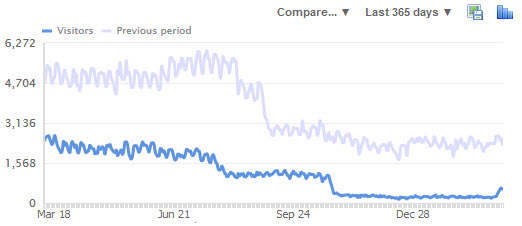
Google's mission statement is "organize the world's information and make it universally accessible and useful."
That mission is so profound & so important the associated court documents in their antitrust cases must be withheld from public consumption.
Hey. The full exhibit list just posted in DC federal court for USA vs Google. J/k, they literally posted the numbers of all of the admitted exhibits which would be unsealed in a sane world where public interest is respected even more so because the defendant is insanely powerful. pic.twitter.com/FViD40xVmf— Jason Kint (@jason_kint) September 23, 2023
Hal Varian was off in his public interviews where he suggested it was the algorithms rather than the amount of data which is prime driver of relevancy.
Apple would not get any revshare if there was a user choice screen & must set Google as the default search engine to qualify for any revshare.
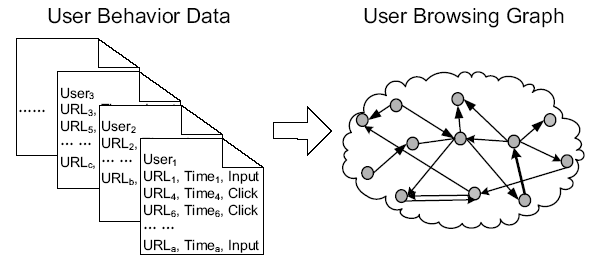
Google has a policy of being vague about using clickstream data to influence ranking, though they have heavily relied upon clickstream data to influence ranking. Advances in machine learning have made it easier to score content to where the clickstream data had become less important.
When Apple Maps launched & Google Maps lost the default position on iOS Google Maps lost 60% of their iOS distribution, and that was with how poorly the Apple Maps roll out went.
Google sometimes subverted their typical auction dynamics and would flip the order of the top 2 ads to boost ad revenues.
Google had a policy of "shaking the cushions" to hit the quarterly numbers by changing advertiser ad prices without informing advertisers that they'd be competing in a rigged auction with artificially manipulated shill bids from the auctioneer competing against them.
When Google talked about hitting the quarterly numbers with shaking the cusions the 5% number which was shared skewed a bit low:
For a brand campaign focused on a niche product, she said the average CPC at $11.74 surged to $25.85 over the last six months, amounting to a 108% increase. However, there wasn’t an incremental return on sales.
“The level to which [price manipulations] happens is what we don’t know,” said Yang. “It’s shady business practices because there’s no regulation. They regulate themselves.”
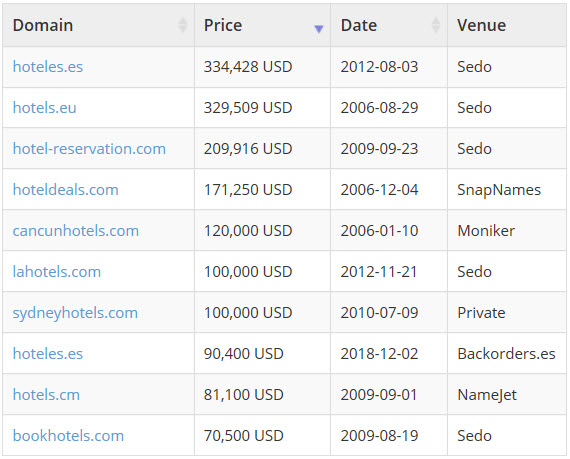
Early in the history of search ads Google blocked trademark keyword bidding. They later allowed it. When keyword bidding on trademarks was allowed it led to a conundrum for some advertisers. If you do not defend your trademark you could lose it, but if you agree with competitors not to bid on each other's trademarks the FTC could come after you - like they did with 1-800 Contacts. This set up forces many brands to participate in auctions where they are arbitraging their own pre-existing brand equity. The ad auctioneer runs shady auctions where it looks across at your account behavior and bids then adjusts bid floors to suck more money out of you. This amounts to something akin to the bid jamming that was done in early Overture, except it is the house itself doing it to you! The last auction I remembered like that was SnapNames, where a criminal named Nelson Brady on the executive team used the handle halverez to leverage participant max bids and put in bids just under their bids. The goal of his fraud? To hit the numbers & get an earn out bonus - similar to how Google insiders were discussing "shaking the cushions" to hit the number.
Halverez created a program which looked across aggregate bid data, join auctions which only had 1 other participant, and then use the one-way view of competing bids to put in a shill bid to drive up costs - which sure sounds conceptually similar to Google's "shaking the cushions."
"Just looking at this very tactically, and sorry to go into this level of detail, but based on where we are I'm afraid it's warranted. We are short __% queries and are ahead on ads launches so are short __% revenue vs. plan. If we don't hit plan, our sales team doesn't get its quota for the second quarter in a row and we miss the street's expectations again, which is not what Ruth signaled to the street so we get punished pretty badly in the market. We are shaking the cushions on launches and have some candidates in May that will help, but if these break in mid-late May we only get half a quarter of impact or less, which means we need __% excess to where we are today and can't do it alone. The Search team is working together with us to accelerate a launch out of a new mobile layout by the end of May that will be very revenue positive (exact numbers still moving), but that still won't be enough. Our best shot at making the quarter is if we get an injection of at least __%, ideally __%, queries ASAP from Chrome. Some folks on our side are running a more detailed, Finance-based, what-if analysis on this and should be done with that in a couple of days, but I expect that these will be the rough numbers.
The question we are all faced with is how badly do we want to hit our numbers this quarter? We need to make this choice ASAP. I care more about revenue than the average person but think we can all agree that for all of our teams trying to live in high cost areas another $___,___ in stock price loss will not be great for morale, not to mention the huge impact on our sales team." - Google VP Jerry Dischler
Google is also pushing advertisers away from keyword-based bidding and toward a portfolio approach of automated bidding called Performance Max, where you give Google your credit card and budget then they bid as they wish. By blending everything into a single soup you may not know where the waste is & it may not be particularly easy to opt out of poorly performing areas. Remember enhanced AdWords campaigns?
Google continues to blur dataflow outside of their ad auctions to try to bring more of the ad spend into their auctions.
Wow. Google. Years behind other browsers (aka monopoly power), Google is attempting to deprecate tracking system A (aka third party cookies) and replace it with another tracking system B (aka Topics) that treats sites as G data mules.
The amount Google is paying Apple to be the default search provider is staggering.
What is $18 billion / year buying ? The DoJ has narrowed in an agreement not to compete between Apple and Google: "Sanford Bernstein estimates Google will pay Apple between $18 billion and $19 billion this year for default search status" https://t.co/HmoZxCZkqm— Tim Wu (@superwuster) September 22, 2023
This is right -- Google was once an extraordinary product, but over time became stagnant & too grabby of random revenue as it ate its ecosystem. Makes it the right time to force Google to try and compete without reaching for its bribery checkbook https://t.co/gDhtDMjfo0— Tim Wu (@superwuster) September 22, 2023
For perspective on the scale of those payments consider that it wasn't that long ago Yahoo! was considered a big player in search and Apollo bought Yahoo! plus AOL from Verizon for about $5 billion & then was quickly able to sell branding & technology rights in Japan to Softbank for $1.6 billion & other miscellaneous assets for nearly a half-billion, reducing the net cost to only $3 billion.
If Google loses this lawsuit and the payments to Apple are declared illegal, that would be a huge revenue (and profit) hit for Apple. Apple would be forced to roll out their own search engine. This would cut away at least 30% of the search market from Google & it would give publishers another distribution channel. Most likely Apple Search would launch with a lower ad density than Google has for short term PR purposes & publishers would have a year or two of enhanced distribution before Apple's ad load matched Google's ad load.
It is hard to overstate how strong Apple's brand is. For many people the cell phone is like a family member. I recently went to upgrade my phone and Apple's local store closed early in the evening at 8pm. The next day when they opened at 10 there was a line to wait in to enter the store, like someone was trying to get concert tickets. Each privacy snafu from Google helps strengthen Apple's relative brand position.
Google has also diluted the quality of their own brand by rewriting search queries excessively to redirect traffic flows toward more commercial interests. Wired covered how Project Mercury works:
This onscreen Google slide had to do with a “semantic matching” overhaul to its SERP algorithm. When you enter a query, you might expect a search engine to incorporate synonyms into the algorithm as well as text phrase pairings in natural language processing. But this overhaul went further, actually altering queries to generate more commercial results. ... Most scams follow an elementary bait-and-switch technique, where the scoundrel lures you in with attractive bait and then, at the right time, switches to a different option. But Google “innovated” by reversing the scam, first switching your query, then letting you believe you were getting the best search engine results. This is a magic trick that Google could only pull off after monopolizing the search engine market, giving consumers the false impression that it is incomparably great, only because you’ve grown so accustomed to it.
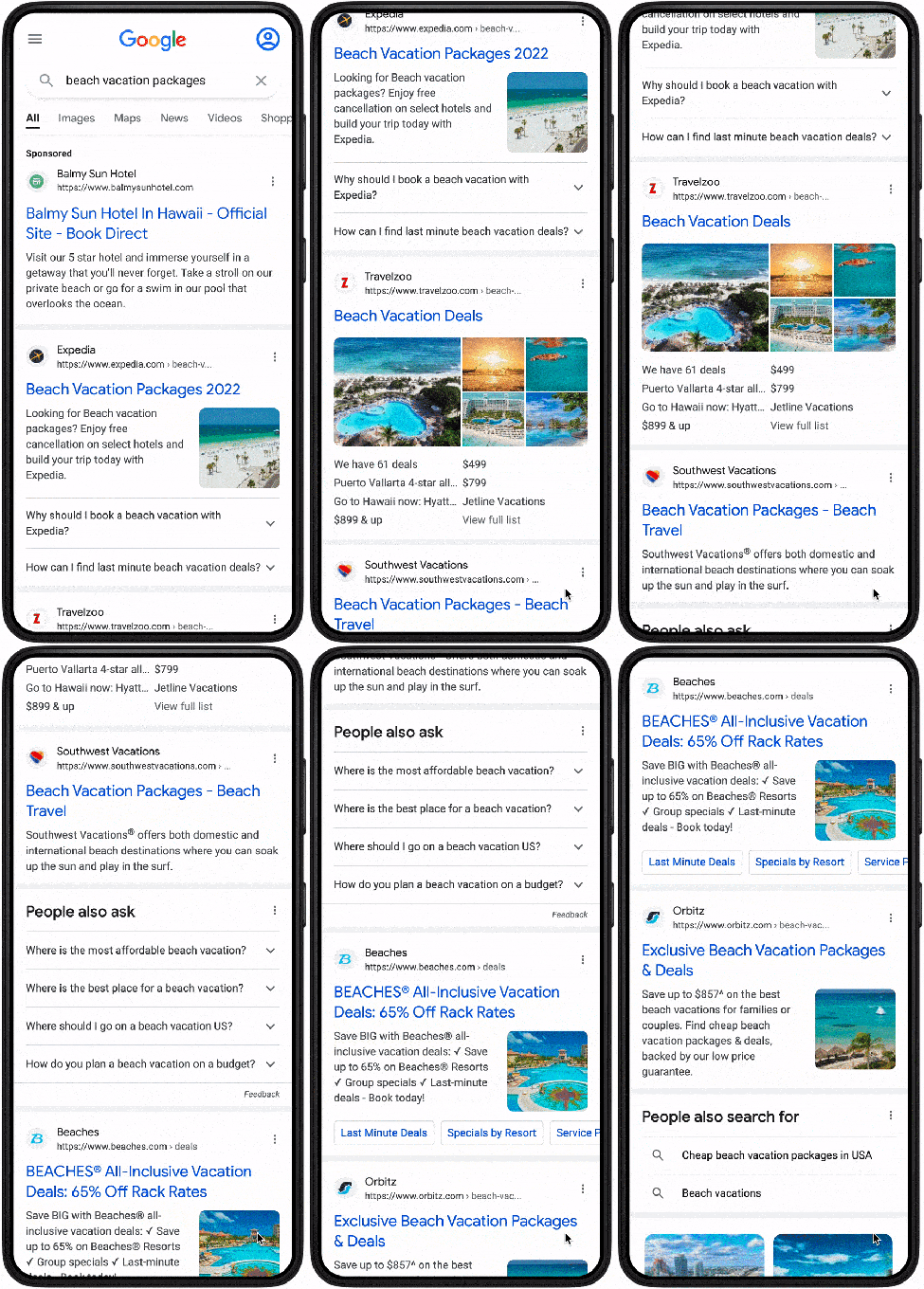
The mobile search results on Google require at least a screen or two of scrolls to get to the organic results if there is a hint of commercial intent behind the search query. Once they have monetized the real estate they are reliant on broader economic growth & using ad buy bundling to drive cross-subsidies of other non-search ad inventory, which may contain more than a bit of fraud. Performance Max may max out your spend without actually performing for anybody other than Google.
Michael Whinston, a professor of economics at the Massachusetts Institute of Technology, said Friday that Google modified the way it sold text ads via “Project Momiji” – named for the wooden Japanese dolls that have a hidden space for friends to exchange secret messages. The shift sought “to raise the prices against the highest bidder,” Whinston told Judge Amit Mehta in federal court in Washington.
While Google's search marketshare is rock solid, the number of search engines available has increased significantly over the past few years. Not only is there Bing and DuckDuckGo but the tail is longer than it was a few years back. In addition to regional players like Baidu and Yandex there's now Brave Search, Mojeek, Qwant, Yep, and You. GigaBlast and Neeva went away, but anything that prohibits selling defaults to a company with over 90% marketshare will likely lead to dozens more players joining the search game. Search traffic will remain lucrative for whoever can capture it, as no matter how much Google tries to obfuscate marketing data the search query reflects the intent of the end user.
“Search advertising is one of the world’s greatest business models ever created…there are certainly illicit businesses (cigarettes or drugs) that could rival these economics, but we are fortunate to have an amazing business.” - Google VP of Finance Mike Roszak
where the unit-level label was instead becomes a favicon
a "Sponsored" label above ads
the URL will show right of the favicon & now the site title will be in a slightly larger font above the URL
An example of the new layout is here:
Displaying a site title & the favicon will allow advertisers to get brand exposure, even if they don't get the click, while the extra emphasis on site name could lead to shifting of ad clicks away from unbranded sites toward branded sites. It may also cause a lift in clicks on precisely matching domains, though that remains to be seen & likely dependes upon many other factors. The favicon and site name in the ads likely impact consumer recall, which can bleed into organic rankings.
After TechCrunch made the above post a Google spokesperson chimed in with an update
Changes to the appearance of Search ads and ads labeling are the result of rigorous user testing across many different dimensions and methodologies, including user understanding and response, advertiser quality and effectiveness, and overall impact of the Search experience. We’ve been conducting these tests for more than a year to ensure that users can identify the source of their Search ads and where they are coming from, and that paid content is clearly labeled and distinguishable from search results as Google Search continues to evolve
The fact it was pre-announced & tested for so long indicates it is both likely to last a while and will in aggregate shift clicks away from the organic result set to the paid ads.
Reading the tea leaves on the pre-announced Google "helpful content" update rolling out next week & over the next couple weeks in the English language, it sounds like a second and perhaps more granular version of Panda which can take in additional signals, including how unique the page level content is & the language structure on the pages.
Like Panda, the algorithm will update periodically across time & impact websites on a sitewide basis.
Cold Hot Takes
The update hasn't even rolled out yet, but I have seen some write ups which conclude with telling people to use an on-page SEO tool, tweets where people complained about low end affiliate marketing, and gems like a guide suggesting empathy is important yet it has multiple links on how to do x or y "at scale."
Trashing affiliates is a great sales angle for enterprise SEO consultants since the successful indy affiliate often knows more about SEO than they do, the successful affiliate would never become their client, and the corporation that is getting their asses handed to them by an affiliate would like to think this person has the key to re-balance the market in their own favor.
My favorite pre-analysis was a person who specialized in ghostwriting books for CEOs Tweeting that SEO has made the web too inauthentic and too corporate. That guy earned a star & a warm spot in my heart.
Profitable Publishing
Of course everything in publishing is trade offs. That is why CEOs hire ghostwriters to write books for them, hire book launch specialists to manipulate the best seller lists, or even write messaging books in the first place. To some Dan Price was a hero advocating for greater equality and human dignity. To others he was a sort of male feminist superhero, with all the Harvey Weinstein that typically entails.
Anyone who has done 100 interviews with journalists see ones that do their job by the book and aim to inform their readers to the best of their abilities (my experiences with the Wall Street Journal & PBS were aligned with this sort of ideal) and then total hatchet jobs where a journalist plants a quote they want & that they said, that they then attributes it to you (e.g. London Times freelance journalist).
There are many dimensions to publishing:
depth
purpose
timing
audience
language
experience
format
passion
uniqueness
frequency
Blogs to Feeds
For a long time indy blogs punched well above their weight due to the incestuous nature of cross-referencing each other, the speed of publishing when breaking news, and how easy feed readers made it to subscribe to your favorite blogs. Google Reader then ate the feed reader market & shut down. And many bloggers who had unique things to say eventually started to repeat themselves. Or their passions & interests changed. Or their market niche disappeared as markets moved on. Starting over is hard & staying current after the passion fades is difficult. Plus if you were rather successful it is easy to become self absorbed and/or lose the hunger and drive that initially made you successful.
Around the same time blogs started sliding people spent more and more time on various social networks which hyper-optimized the slot machine type dopamine rush people get from refreshing the feed. Social media largely replaced blogs, while legacy media publishers got faster at putting out incomplete news stories to be updated as they gather more news. TikTok is an obvious destination point for that dopamine rush - billions of short pieces of content which can be consumed quickly and shared - where the user engagement metrics for each user are tracked and aggregated across each snippet of media to drive further distribution.
Burnout & Changing Priorities
I know one of the reasons I blog less than I used to is a lot of the things I would write would be repeats. Another big reason was when my wife was pregnant I decided to shut down our membership site so I could take my wife for a decently long walk almost everyday so her health was great when it came time to give birth & ensure I had spare capacity for if anything went wrong with the pregnancy process. As a kid my dad was only around much for a few summers and I wanted to be better than that for my kid.
The other reason I cut back on blogging is at some point search went from a endless blue water market to a zero sum game to a negative sum game (as ad clicks displaced organic clicks). And in such an environment if you have a sustainable competitive advantage it is best to lean into it yourself as hard as you can rather than sharing it with others. Like when we had an office here our link builders I trained were getting awesome unpaid links from high-trust sources for what backed out to about $25 of labor time (and no more than double that after factoring in office equipment, rent, etc.).
If I share that script / process on the blog publicly I would move the economics against myself. At the end of the day business is margins, strategy, market, and efficiency. Any market worth being in is going to have competition, so you need to have some efficiency or strategic differentiators if you are going to have sustainable profit margins. I've paid others many multiples of that for link building for many years back when links were the primary thing driving rankings.
I don't know the business model where sharing the above script earns more than it costs. Does one launch a Substack priced at like $500 or $1,000 a month where they offer a detailed guide a month? How many people adopt the script before the response rates fall & it offsets the costs by more than the revenues? My issue with consulting is I always wanted to over-deliver for clients & always ended up selling myself short when compared to publishing, so I just stick with a few great clients and a bit of this and that vs going too deep & scaling up there. Plus I had friends who went big and then some of their clients who were acquired had the acquirer brag about the SEO, that lead to a penalty, then the acquirer of the client threw the SEO under the bus and had their business torched.
When you have a kid seeing them learn and seeing wonderment in their eyes is as good as life gets, but if you undermine your profit margins you'd also be directly undermining your own child's future ... often to help people who may not even like you anyhow. That is ultimately self defeating as it gets, particularly as politics grow more polarized & many begin to view retribution as a core function of government.
I believe there are no limits to the retributive and malicious use of taxation as a political weapon. I believe there are no limits to the retributive and malicious use of spending as a political reward.
Margins
The role of search engines is to suck as much of the margins as they can out of publishing while trying to put some baseline floor on content quality so that people would still prefer to use a search engine rather than some other reference resource. Google sees memes like "add Reddit to the end of your search for real content" as an attack on their own brand. Google needs periodic large shake ups to reaffirm their importance, maintain narrative control around innovation, and to shake out players with excessive profit margins who were too well aligned with the current local maxima. Google needs aggressive SEO efforts with large profits to have an "or else" career risk to them to help reign in such efforts.
Google said the helpful content update system is automated, regularly evaluating content. So the algorithm is constantly looking at your content and assigning scores to it. But that does not mean, that if you fix your content today, your site will recover tomorrow. Google told me there is this validation period, a waiting period, for Google to trust that you really are committed to updating your content and not just updating it today, Google then ranks you better and then you put your content back to the way it was. Google needs you to prove, over several months - yes - several months - that your content is actually helpful in the long run.
If you thought a site were quality, had some issues, the issues were cleaned up, and you were still going to wait to rank it appropriately ... the sole and explicit purpose of that delay is career risk to others to prevent them flying to close to the sun - to drive self regulation out of fear.
Brand counts for a lot in search & so does buying the default placement position - look at how much Google pays Apple to not compete in search, or look at how Google had that illegal ad auction bid rigging gentleman's agreement with Facebook to not compete with a header bidding solution so Google could maintain their outsized profit margins on ad serving on third party websites.
Business ultimately is competition. Does Google serve your ads? What are the prices charged to players on each side of each auction & how much rake can the auctioneer capture for themselves?
The Auctioneer's Shill Bid - Google Halverez (beta)
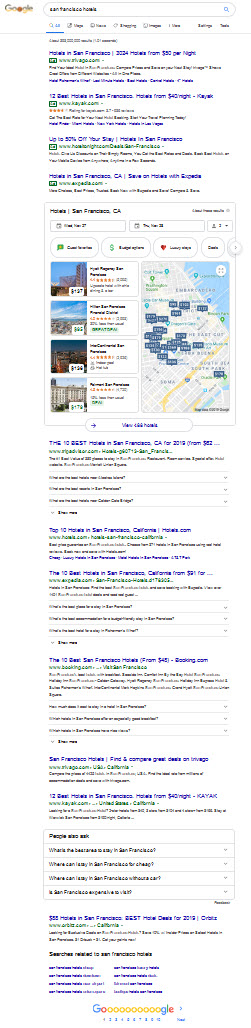
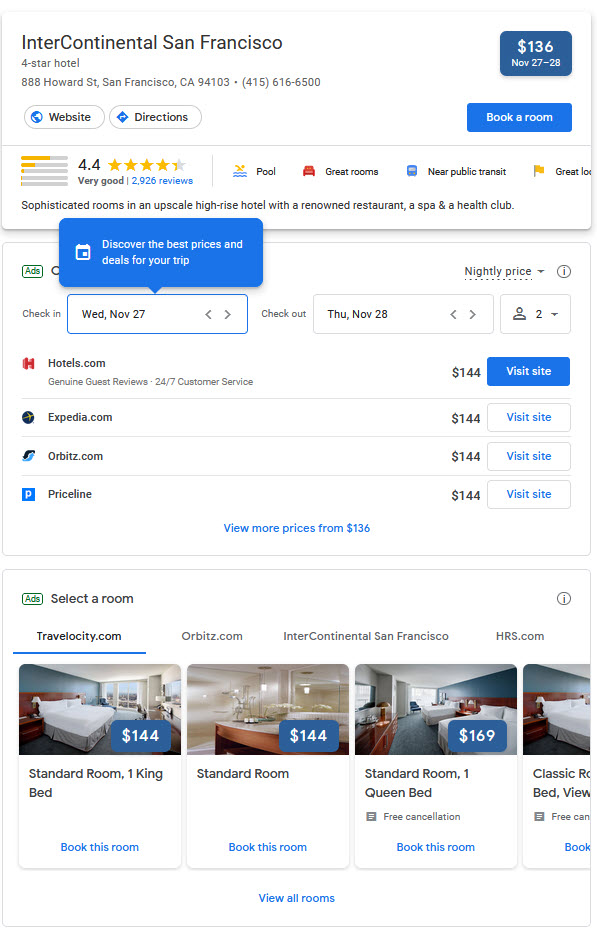
That is why we see Google embedding more features directly in their search results where they force rank their vertical listings above the organic listings. Their vertical ads are almost always placed above organics & below the text AdWords ads. Such vertical results could be thought of as a category-based shill bid to try to drive attention back upward, or move traffic into a parallel page where there is another chance to show more ads.
Google runs its search engine partly on its internally developed Cloud TPU chips. The chips, which the company also makes available to other organizations through its cloud platform, are specifically optimized for artificial intelligence workloads. Google’s newest Cloud TPU can provide up to 275 teraflops of performance, which is equivalent to 275 trillion computing operations per second.
Now that computing power can be run across:
millions of books Google has indexed
particular publishers Google considers "above board" like Reuters, AP, the New York Times, the Wall Street Journal, etc.
historically archived content from trusted publishers before "optimizing for search" was actually a thing
... and model language usage versus modeling the language usage of publishers known to have weak engagement / satisfaction metrics.
Low end outsourced content & almost good enough AI content will likely tank. Similarly textually unique content which says nothing original or is just slapped together will likely get downranked as well.
Expect Volatility
They would not have pre-announced the update & gave some people some embargoed exclusives unless there was going to be a lot of volatility. As typical with the bigger updates, they will almost certainly roll out multiple other updates sandwiched together to help obfuscate what signals they are using & misdirect people reading too much in the winners and losers lists.
Do you have an existing or intended audience for your business or site that would find the content useful if they came directly to you?
Does your content clearly demonstrate first-hand expertise and a depth of knowledge (for example, expertise that comes from having actually used a product or service, or visiting a place)?
Does your site have a primary purpose or focus?
After reading your content, will someone leave feeling they’ve learned enough about a topic to help achieve their goal?
Will someone reading your content leave feeling like they’ve had a satisfying experience?
Are you keeping in mind our guidance for core updates and for product reviews?
As a person who has ... erm ... put a thumb on the scale for a couple decades now, one can feel the algorithmic signals approximated by the above questions.
To the above questions they added:
Is the content primarily to attract people from search engines, rather than made for humans?
Are you producing lots of content on different topics in hopes that some of it might perform well in search results?
Are you using extensive automation to produce content on many topics?
Are you mainly summarizing what others have to say without adding much value?
Are you writing about things simply because they seem trending and not because you'd write about them otherwise for your existing audience?
Does your content leave readers feeling like they need to search again to get better information from other sources?
Are you writing to a particular word count because you've heard or read that Google has a preferred word count? (No, we don't).
Did you decide to enter some niche topic area without any real expertise, but instead mainly because you thought you'd get search traffic?
Does your content promise to answer a question that actually has no answer, such as suggesting there's a release date for a product, movie, or TV show when one isn't confirmed?
One of the interesting things about the broader scope of algorithm shifts is each thing that makes the algorithms more complex, increases barrier to entry, and increases cost ultimately increases the chunk size of competition. And when that is done what is happening is the macroparasite is being preference over the microparasite. Conceptually Google has a lot of reasons to have that bias or preference:
fewer entities to police (lower cost)
more data to use to police each entity (higher confidence)
easier to do direct deals with players which can move the needle (more scale)
if markets get too consolidated Google can always launch a vertical service & tip the scale back in the other direction (I see your Amazon ad revenue and I raise you free product listing ads, aggregated third party reviews, in-SERP product comparison features, and a "People Also Ask" unit)
the macroparasites have more "sameness" between them (making it easier for Google to create a competitive clone or copy)
So long as Google maintains a monopoly on web search the bias toward macroparasites works for them. It gives Google the outsized margins which ensures healthy Alphabet profit margins even if the median of Google's 156,000+ employees pulls down nearly $300,000 a year. People can not see what has no distribution, people do not know what exist in invisibility, nor do they know which innovations were held back and what does not exist due to the current incentive structures in our monopoly-controlled publishing ecosystem.
I think when people complain about the web being inauthentic what they are really complaining about is the algorithmic choices & publishing shifts that did away with the indy blogs and replaced them with the dopamine feed viral tricks and the same big box scaled players which operate multiple parallel sites to where you are getting the same machinery and content production house behind multiple consecutive listings. They are complaining about the efforts to snuff out the microparasite also scrubbing away personality, joy, love, quirkiness, weirdness, and the zany stuff you would not typically find on content by factory order websites.
Let's Go With Consensus Here!
The above leads you down well worn paths, rather than the magic of serendipity & a personality worn on your sleeve that turns some people on while turning other people off.
If you believe this effort will enhance info literacy, and that it represents evolved search, you're an idiot.
Sharyl Attkisson gave us the head's up that they'd push censorship controls as "media literacy" several years ago.— john andrews (@johnandrews) August 13, 2022
History is written by the victors. Consensus is politically driven, backward looking, and has key messages memory holed.
I spent new years in China before the COVID-19 crisis hit & got sick when I got back. I used so much caffeine the day I moved over a half dozen computers between office buildings while sick. I week later when news on Twitter started leaking of the COVID-19 crisis hit I thought wow this looks even worse than what I just had. In the fullness of time I think I had it before it was a crisis. Everyone in my family got sick and multiple people from the office. Then that COVID-19 crisis news came out & only later when it was showed that comorbidities and the elderly had the worse outcomes did I realize they were likely the same. Then after the crisis had been announced someone else from the office building I was in got it & then one day it was illegal to go into the office. The lockdown where I lived was longer than the original lockdown in Wuhan. Those lockdowns destroyed millions of lives.
The reason the response to the COVID-19 virus was so extreme was huge parts of politically interested parties wanted to stop at nothing to see orange man ejected from the White House. So early on when he blocked flights from China you had prominent people in political circles calling him xenophobic, and then the head of public health in New York City was telling you it was safe to ride the subway and go about your ordinary daily life. That turned out to be deadly partisan hackery & ignorance pitched as enlightenment, leading to her resignation.
Then the virus spreads wildly as one would expect it to. And draconian lockdowns to tank the economy to ensure orange man was gone, mail in voting was widespread, and the election was secured.
I actually appreciate Sam Harris for saying this out loud. This is what the vast majority of the anti Trump crowd believes, but most of them won’t say it. At least when it’s said, you can see it for what it is.pic.twitter.com/NmOqshoZlS— Dave Smith (@ComicDaveSmith) August 18, 2022
Some of the most ridiculous heroes during this period wrote books about being a hero. Andrew "killer" Cuomo had time to write his "did you ever know that I'm your hero" book while he simultaneously ordered senior living homes to take in COVID-19 positive patients. Due to fecal-oral transmission and poor health outcomes for senior citizens sick enough to be in a senior living home his policies lead to the manslaughter of thousands of senior citizens.
You couldn't go to a funeral and say goodbye because you might kill someone else's grandma, but if you were marching for social justice (and ONLY social justice) that stuff was immune to the virus.
Ron DeSantis on public health experts making an exception to lockdowns for George Floyd protests: “That's when I knew these people are a bunch of frauds”
Suggesting looking at the root problems like no dad in the home is considered sexist, racist, or both. Meanwhile social justice organizations champion tearing down the nuclear family in spite of the fact that if you tear down the family all you are left with is the collective AND "mandatory collectivism has ended in misery wherever it’s been tried."
Of course the social justice stuff embeds the false narrative of victimhood, which then turns many of the fake victims into monsters who destroy the lives of others - but we are all in this together.
Absolutely nobody could have predicted the rise of murder & violent crime as we emptied the prisons & decriminalized large swaths of the penal code. Plus since many crimes are repeatedly ignored people stop reporting lesser crimes, so the New York Times can tell you not to worry overall crime is down.
In Seattle if someone rapes you the police probably won't even take a report to investigate it unless (in some cases?) you are a child. What are police protecting society from if rape is a freebie that doesn't really matter? Why pay taxes or have government at all?
What Google Wants
The above sidebar is the sort of content Google would not want to rank in their search results. :D
They want to rank text which is perhaps factually correct (even if it intentionally omits the sort of stuff included above), and maybe even current and informed, but done in such a way where you do not feel you know the author the way you might think you do if you read a great novel. Or hard biased content which purports to support some view and narrative, but is ultimately all just an act, where everything which could be of substance is ultimately subsumed by sales & marketing.
"The best relevancy algorithm in the world is trumped by preferential placement of inferior results which bypasses the algorithm."
I was a fool to dismiss Aaron for years as a cynic. He was an oracle, not a conspiracy theorist: https://t.co/V68vIXXNPI— Rand Fishkin (@randfish) November 20, 2019
The Market for Something to Believe In is Infinite
Each re-representation mash-up of content in the search results decontextualizes the in-depth experience & passion we crave. Each same "big box" content factory where a backed entity can withstand algorithmic volatility & buy up other publishers to carry learnings across to establish (and monetize) a consensus creates more of a bland sameness.
That barrier to entry & bland sameness is likely part of the reason the recent growth of Substack, which sort of acts just like a blog did 15 or 20 years ago - you go direct to the source without all the layers of intermediaries & dumbing down you get as a side effect of the scaled & polished publishing process.
Kent Walker promotes public policies which advantage the Google monopoly.
His role doing that means he has to write some really bad hot takes that lack context or intentionally & dishonestly redirect attention away from core issues - that's his job.
"When you have an urgent question — like “stroke symptoms” — Google Search could be barred from giving you immediate and clear information, and instead be required to direct you to a mix of low quality results."
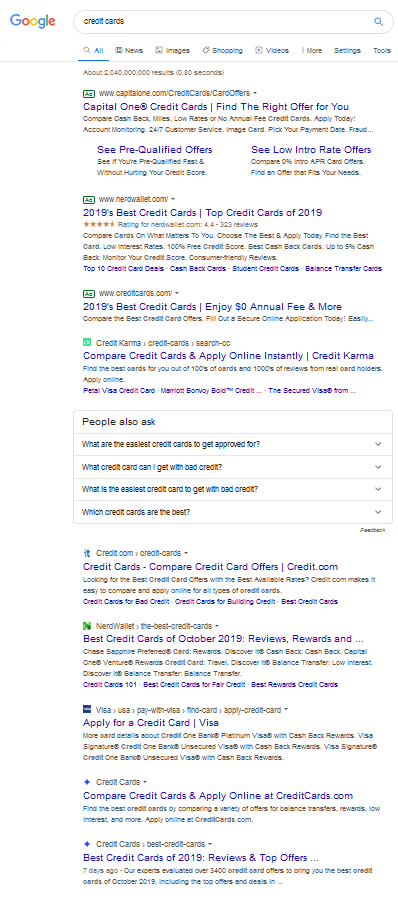
On some search queries users get a wall of Google ads, the forced ranked Google insert (or sometimes multiple of them with local & ecommerce) and then there can even be a "people also ask" box above the first organic result.
The idea that organic results must be low quality if not owned & operated indicates 1 of the following 3 must be true:
they should not be in search
their content scraping & various revenue shifting scams with their ad tech stack demonetized legit publishers
their forced rank of their own content is stripping them of the signals needed to rank websites & pages
Whenever Google puts a "people also ask" box above the first organic result that is them saying they did not know what to rank, or they are just trying to create a visual block to push the organic result set down the page and user attention back up toward the ads.
The solution to Google's claims is easy to solve. Either of the following would work.
Have an API that allows user choice (to set rich snippet or vertical defaults in various categories), or
If the vertical inserts remain Google-only then for Google to justify force ranking their own results above the organic result set Google should also be required to rank those same results above all of their ads, so that Google is demonetizing Google along with the rest of the ecosystem, rather than just demonetizing third parties.
If the thesis that this information needs to be front and center & that is a matter of life or death, then asking searchers to first scroll past a page or two of ads is not particularly legitimate.
Spam & Security
"when you use Google Search or Google Play, we might have to give equal prominence to a raft of spammy and low-quality services."
If Google did not force rank Google local results above the rest of the organic result set then the fake locksmiths would not have ranked.
I have lost count of how many articles I have read about hundreds or thousands of fake apps in the Google Play store which existed to defraud advertisers or commit identity theft, but there have been literally thousands of such articles. I see a similar headline at least once a month without eve looking for them. Here is one this week for scammers monetizing the popularity of Wordle with fake apps.
Making matters worse, some of the tech support scams showed the URL of a real business and rerouted the call through a Google number directly to a scammer. A searcher who trusted Google & sees Apple.com or Dell.com on Google Ads in the search results then got connected with a scammer who would commit identity theft or encrypt their computer then demand ransom cryptocurrency payments to decrypt it.
After making the ads harder to run for scammers Google decided the problem was too hard & expensive to sort out so they also blocked legitimate computer repair shops.
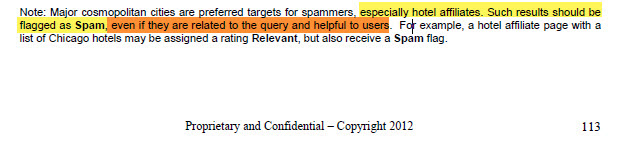
Sometimes Google considers something spam strictly due to financial considerations.
At one point Google got busted for helping an advertiser route around the automated safety features built into their ad network so that they could pay Google to run ads promoting illegal steroids.
With cartels, you can only buy illegal goods and services from the cartel if you don't want to suffer ill consequences. The same appears to be true here.
The China Problem
"Handicapping America’s technology leaders would threaten our leading sources of research and development spending — just as bipartisan voices in Congress are recognizing the need to increase American R&D investment to stay competitive in the global race for AI, quantum, and other advanced technologies."
We are patriotic, and, but China... is a favorite misdirection of a tech monopolist.
"the online services targeted by these bills have reduced prices; these bills say nothing about sectors where prices have actually been rising and contributing to inflation."
Technology is no doubt deflationary (moving bits on an optical line is cheaper than printing out a book and shipping it across the world) BUT some dominant channels have increased the cost of distribution by increasing the chunk size of information and withholding performance information.
Before Google Analytics was "free" there was a rich and vibrant set of competition in web analytics software with lots of innovation from players like ClickTracks.
Most competing solutions went away.
Google moved away from an installed licensing model to a hosted service where they can change the price upon contract renewal.
Search hid progressively more performance information over time, only sampled data from larger data sets, & now you can sign up for Google Analytics 360 starting at only $150,000 per year.
The hidden search performance data also has many layers to that onion. Not only does Google not show keyword referrers on organic search, but they often don't show your paid search keywords either, and they keep extending out keyword targeting broader than advertisers intend.
Yesterday's announcement on match type changes had me crawling through query data this morning. I'm staring at many 2-3 word exact match keywords that are matching to 8-word queries. G thinks 'deck paint' and 'how do i put paint on my deck' mean the exact same thing. CPA is 10x.— Brad Geddes (@bgtheory) February 5, 2021
Google used to pay Brad Geddes to run official Google AdWords ad training seminars for advertisers, so the idea that *he* has to express his frustrations on Twitter is an indication of how little effort Google is putting into having open communications channels or caring about what their advertisers think.
he told her that the whole idea of customer support was ridiculous. Rather than assuming the unscalable task of answering users one by one, Page said, Google should enable users to answer one another's questions.
Those who were paying for ads get the above "serve yourself" treatment, all the while Google regularly resets user default ad settings to extend out ad distribution, automatically ad keywords, shift to enhanced AdWords ad campaigns, etc.
Then there are other features which would be beneficial and offered in a competitive market that have been deprioritized. Many years ago eBay did a study which showed their branded Google AdWords ad buys were cannibalistic to eBay profits. Google maintained most advertisers could not conduct such a study because it would be too expensive and Google does not make the feature set available as part of their ad suite.
Missing Information
"When you search for local businesses, Google Search and Maps may be prohibited from highlighting information we gather about hours of operation, contact information, and reviews. That could hurt small businesses and local retailers, as well as their customers."
Claiming reviews or an attempt to offer a comprehensive set of accurate review data as a strong point would be economical with the truth.
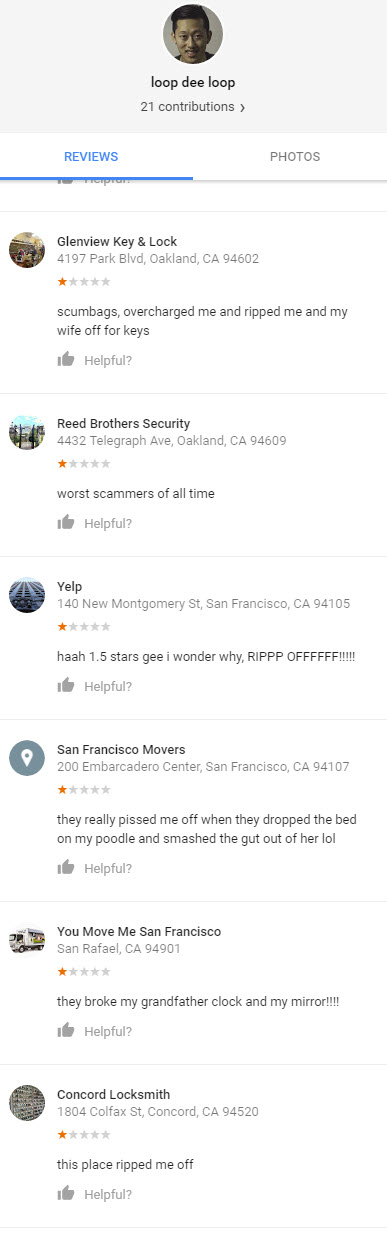
Back when I had a local business page my only review was from a locksmith spammer / scammer who praised his own two businesses, trashed a dozen other local locksmiths, crapped on a couple local SEO services, and joked about how a local mover smashed the guts out of his dog. Scammer fake reviewer's name was rather sophisticated ... it was ... Loop Dee Loop
After Yelp turned down an acquisition offer by Google & Yelp did a great job making some people aware of how Google was stealing their reviews wholesale without attribution Google bought Zagat & Fromer's to augment the Google local review data and then sold those businesses off.
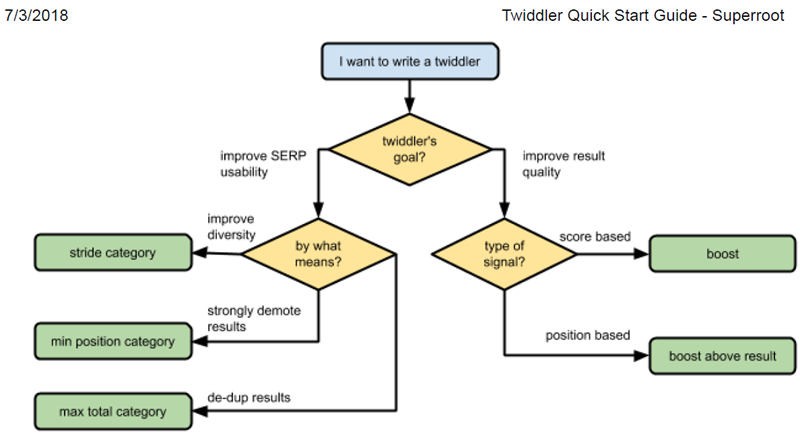
Ultimately with the above sort of stuff Google is primarily a volume aggregator or has lower editorial costs than pure plays due to the ability to force bundle their own distribution. And they use the ability to rank themselves above a neutral algorithmic position as a core part of their biz dev strategy. When shopping search engines were popular Google kept rewording the question set they sent remote raters to justify rank demotion for shopping search engines & Google also came up with innovative ranking "signals" like concurrent ranking of their own vertical search offering whenever competitors x or y are shown in the result set & rolled out a "diversity" algorithm to limit how many comparison shopping sites could appear in the search results. The intent of the change was strictly anti-competitive:
"Although Google originally sought to demote all comparison shopping websites, after Google raters provided negative feedback to such a widespread demotion, Google implemented the current iteration of its so-called 'diversity' algorithm."
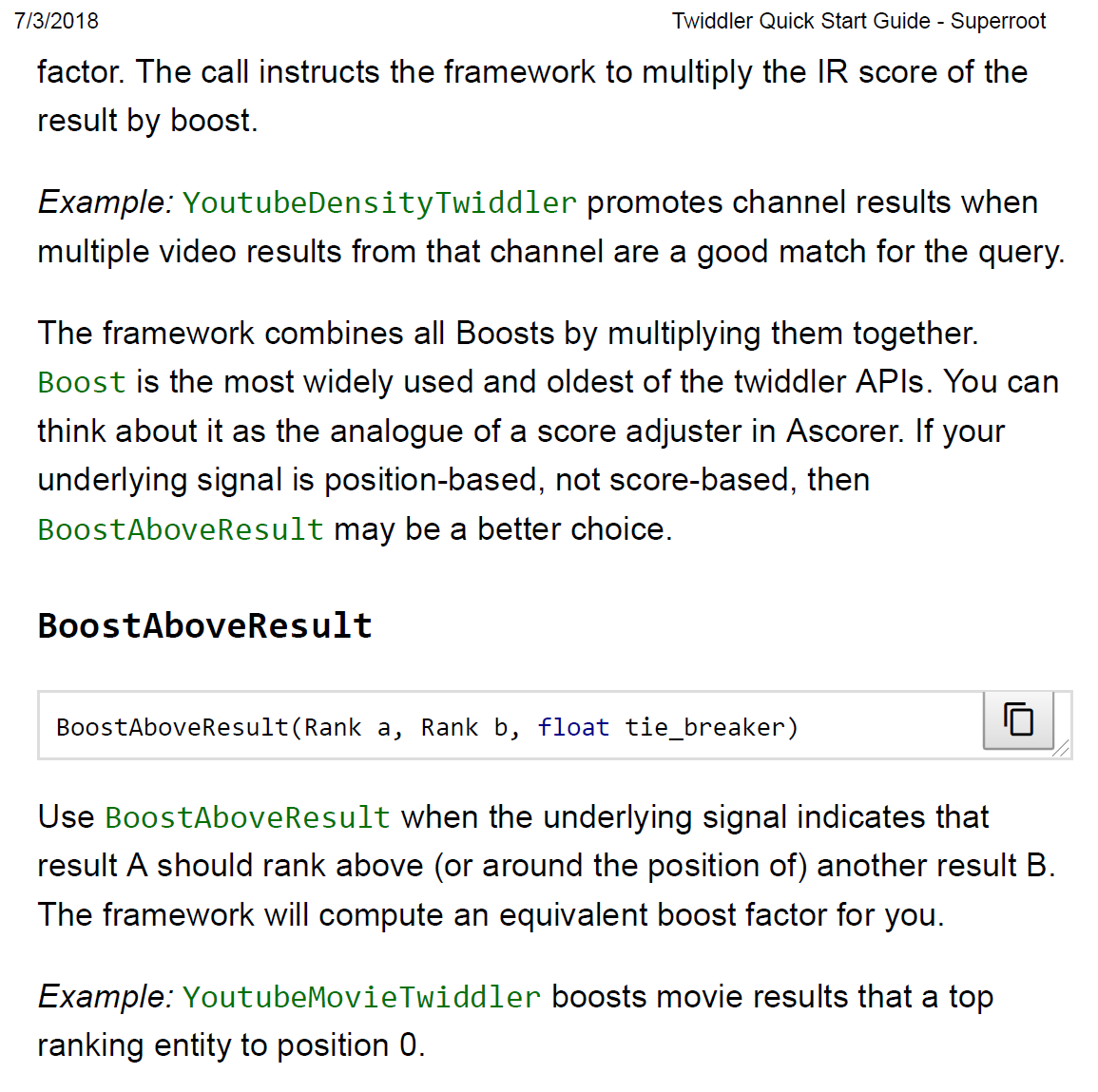
As a matter of fact, part of one of many document dumps in recent years went further than the old concurrent ranking signal to a rank x above y feature which highlights how YouTube can be hard coded at a number 1 ranking position.
Part of that guide highlighted how to hardcode ranking YouTube #1.
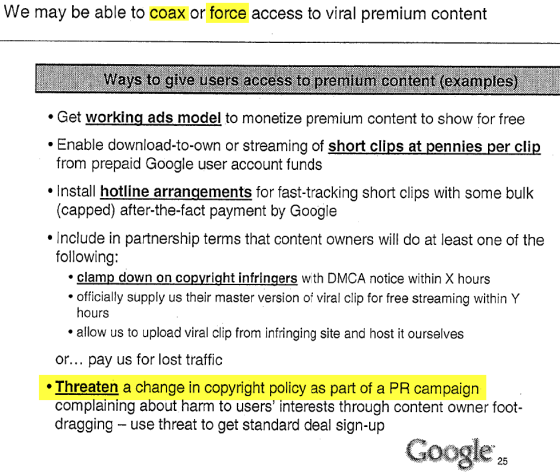
If you re-represent content & can force rank yourself #1 (with larger listings) that can be used to force other players onto your platform on your terms. Back when YouTube was must less of a sure thing Google suggested they could threaten to change copyright.
This same approach to "relevancy" is everywhere.
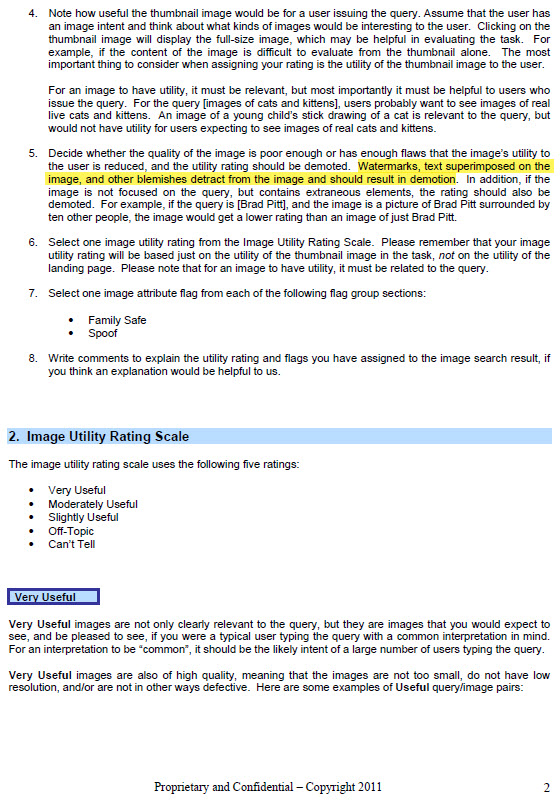
Did you watermark your images? Well shame on you, as that is good for a rank demotion
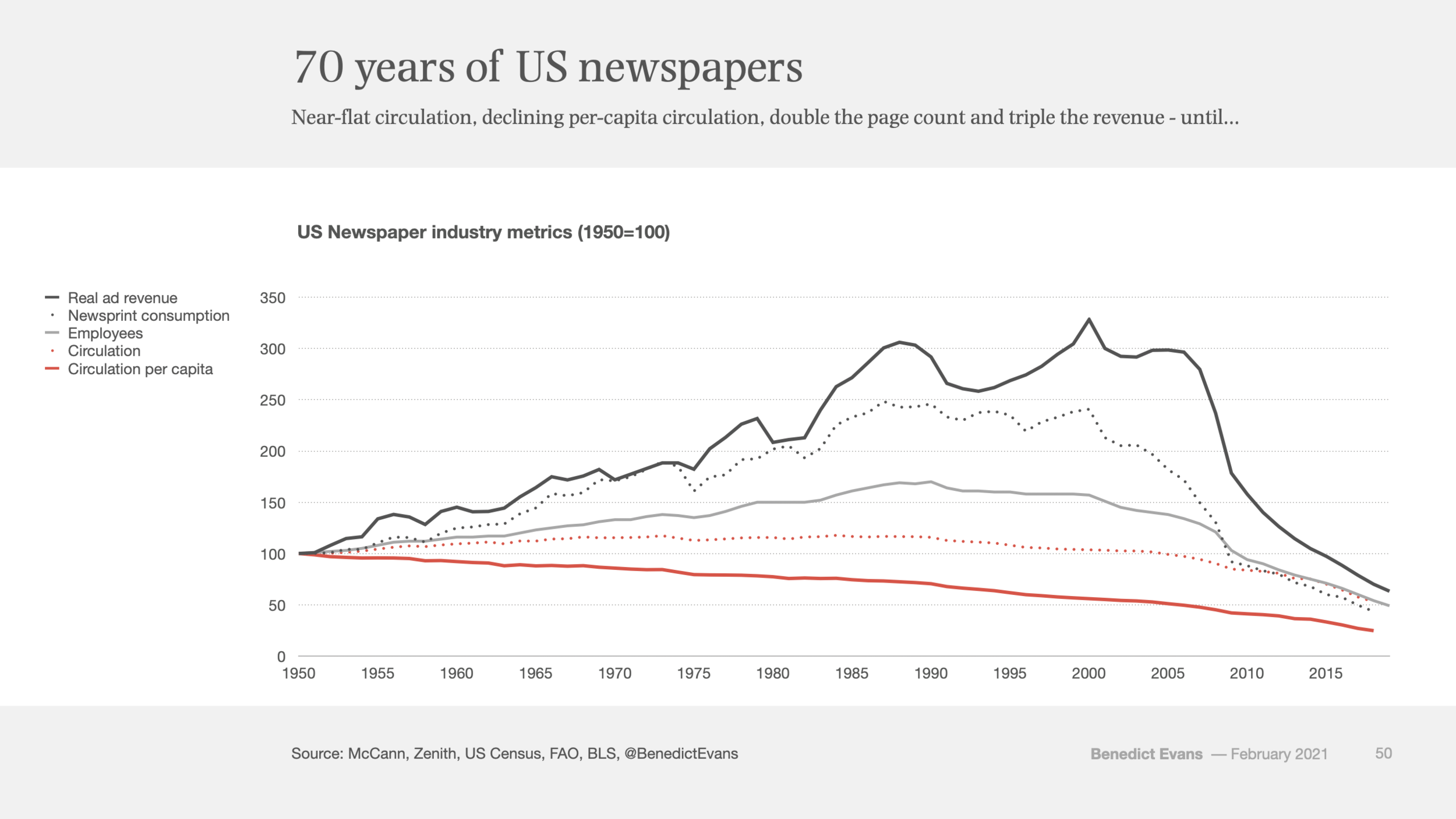
Now there are some issues where there is missing information. These areas involve original reporting on local politics & are called news deserts. As the ad pie has consolidated around Google & Facebook that has left many newspapers high and dry.
Private equity players like Alden Global Capital buy up newspapers, fire journalists, and monetize brand equity as they drive the papers into the ground.
Google has maintained they do not make any money from news search, but the states lawsuit around ad tech made it clear Google promoted AMP for anti-competitive purposes to block header bidding, lied to news publishers to get them to adopt AMP and eat the tech costs of implementation, did a deal with their biggest competitor in online advertising Facebook to maintain the status quo, charge over double what their competitors do for ad tech, and had a variety of bid rigging auction manipulation algorithms they used to keep funneling more money to themselves.
Internally they had an OKR to make *most* search clicks land on AMP pages within a year of launch
"AMP launched as an open source project in October 2015, with 26 publishers and over 40 publications already publishing AMP files for our preview demo. Our team built g.co/ampdemo and is now racing towards launching it for all of our users. We're responsible for the AMP @ Google integrations, particularly focusing on Search, our most visible product. We have a Google-wide 2016 OKR to deliver! By the end of 2016, our goal is that 50%+ of content consumed through Search is being consumed through AMP."
You don't get over half the web to shift to a proprietary version of HTML in under a year without a lot of manipulation.
So, when Google tells buyers an ad sold for one price and they tell sellers it sold for a lower price, isn't that just plain old fraud? I mean, on top of the anti-competitive tying and all that, fraud is illegal, isn't it?— Jerry Neumann (@ganeumann) January 14, 2022
Old Google (pre-Panda) was to some degree largely the following: links = rank.
Once you had enough links to a site you could literally pour content into a site like water and have the domain's aggregate link authority help anything on that site rank well quickly.
As much as PageRank was hyped & important, having a diverse range of linking domains and keyword-focused anchor text were important.
Brand = Rank
After Vince then Panda a site's brand awareness (or, rather, ranking signals that might best simulate it) were folded into the ability to rank well.
Panda considered factors beyond links & when it first rolled out it would clip anything on a particular domain or subdomain. Some sites like HubPages shifted their content into subdomains by users. And some aggressive spammers would rotate their entire site onto different subdomains repeatedly each time a Panda update happened. That allowed those sites to immediately recover from the first couple Panda updates, but eventually Google closed off that loophole.
Any signal which gets relied on eventually gets abused intentionally or unintentionally. And over time it leads to a "sameness" of the result set unless other signals are used:
Google is absolute garbage for searching anything related to a product. If I'm trying to learn something invariably I am required to search another source like Reddit through Google. For example, I became introduced to the concept of weighted blankets and was intrigued. So I Google "why use a weighted blanket" and "weighted blanket benefits". Just by virtue of the word "weighted blanket" being in the search I got pages and pages of nothing but ads trying to sell them, and zero meaningful discourse on why I would use one
Getting More Granular
Over time as Google got more refined with Panda broad-based sites outside of the news vertical often fell on tough times unless they were dedicated to some specific media format or had a lot of user engagement metrics like a strong social network site. That is a big part of why the New York Times sold About.com for less than they paid for it & after IAC bought it they broke it down into a variety of sites like: Verywell (health), the Spruce (home decor), the Balance (personal finance), Lifewire (technology), Tripsavvy (travel) and ThoughtCo (education & self-improvement).
Penguin further clipped aggressive anchor text built on low quality links. When the Penguin update rolled out Google also rolled out an on-page spam classifier to further obfuscate the update. And the Penguin update was sandwiched by Panda updates on either side, making it hard for people to reverse engineer any signal out of weekly winners and losers lists from services that aggregate massive amounts of keyword rank tracking data.
So much of the link graph has been decimated that Google reversed their stance on nofollow to where in March 1st of this year they started treating it as a hint versus a directive for ranking purposes. Many mainstream media websites were overusing nofollow or not citing sources at all, so this additional layer of obfuscation on Google's part will allow them to find more signal in that noise.
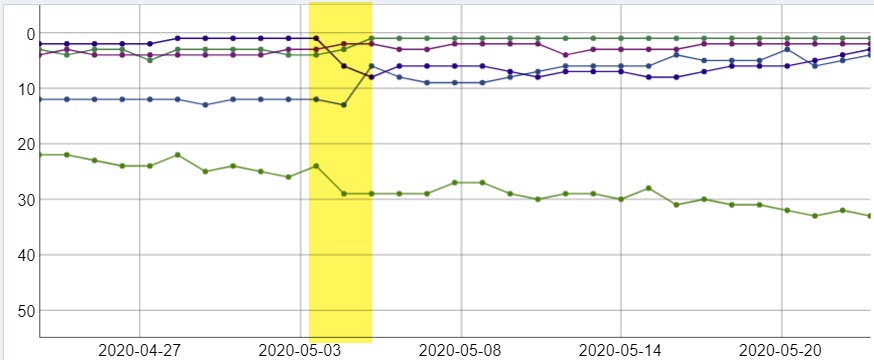
May 4, 2020 Algo Update
On May 4th Google rolled out another major core update.
Later today, we are releasing a broad core algorithm update, as we do several times per year. It is called the May 2020 Core Update. Our guidance about such updates remains as we’ve covered before. Please see this blog post for more about that:https://t.co/e5ZQUAlt0G— Google SearchLiaison (@searchliaison) May 4, 2020
I saw some sites which had their rankings suppressed for years see a big jump. But many things changed at once.
"Google’s pretty much made it explicit that they’re not going to propagate news sites when it comes to election related queries and you scroll and you get a giant election widget in your phone and it shows you all the different data on the primary results and then you go down, you find Wikipedia, you find other like historical references, and before you even get to a single news article, it’s pretty crazy how Google’s changed the way that the SERP is intended."
That change reflects the permanent change to the news media ecosystem brought on by the web.
The Internet commoditized the distribution of facts. The "news" media responded by pivoting wholesale into opinions and entertainment.— Naval (@naval) May 26, 2016
YMYL
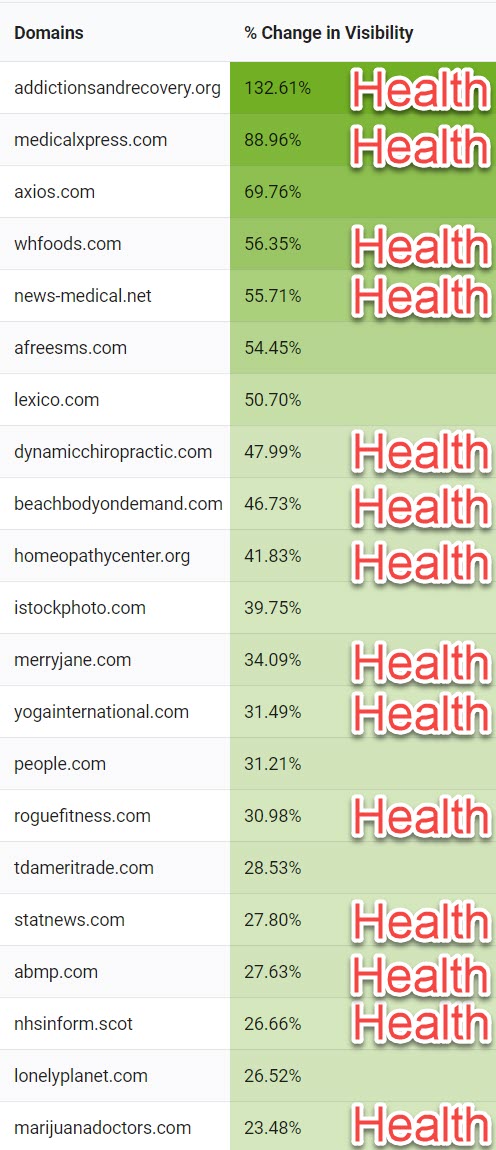
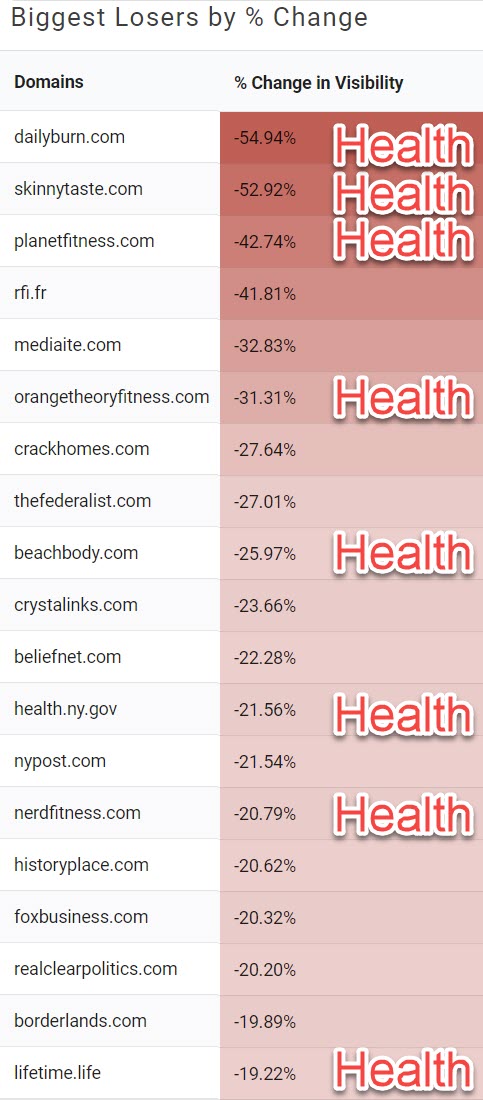
A blog post by Lily Ray from Path Interactive used Sistrix data to show many of the sites which saw high volatility were in the healthcare vertical & other your money, your life (YMYL) categories.
Seeing this all but cements the notion (in my mind at least) that Google did not want content unrelated to the main purpose of the page to appear above the fold to the exclusion of the page's main content! Now for the second wrinkle in my theory.... A lot of the pages being swapped out for new ones did not use the above-indicated format where a series of "navigation boxes" dominated the page above the fold.
The above shift had a big impact on some sites which are worth serious money. Intuit paid over $7 billion to acquire Credit Karma, but their credit card affiliate pages recently slid hard.
Credit Karma lost 40% traffic from May core update. That’s insane, they do major TV ads and likely pay millions in SEO expenses. Think about that folks. Your site isn’t safe. Google changes what they want radically with every update, while telling us nothing!— SEOwner (@tehseowner) May 14, 2020
The above sort of shift reflects Google getting more granular with their algorithms. Early Panda was all or nothing. Then it started to have different levels of impact throughout different portions of a site.
Brand was sort of a band aid or a rising tide that lifted all (branded) boats. Now we are seeing Google get more granular with their algorithms where a strong brand might not be enough if they view the monetization as being excessive. That same focus on page layout can have a more adverse impact on small niche websites.
One of my old legacy clients had a site which was primarily monetized by the Amazon affiliate program. About a month ago Amazon chopped affiliate commissions in half & then the aggressive ad placement caused search traffic to the site to get chopped in half when rankings slid on this update.
Their site has been trending down over the past couple years largely due to neglect as it was always a small side project. They recently improved some of the content about a month or so ago and that ended up leading to a bit of a boost, but then this update came. As long as that ad placement doesn't change the declines are likely to continue.
They just recently removed that ad unit, but that meant another drop in income as until there is another big algo update they're likely to stay at around half search traffic. So now they have a half of a half of a half. Good thing the site did not have any full time employees or they'd be among the millions of newly unemployed. That experience though really reflects how websites can be almost like debt levered companies in terms of going under virtually overnight. Who can have revenue slide around 88% and then take increase investment in the property using the remaining 12% while they wait for the site to be rescored for a quarter year or more?
"If you have been negatively impacted by a core update, you (mostly) cannot see recovery from that until another core update. In addition, you will only see recovery if you significantly improve the site over the long-term. If you haven’t done enough to improve the site overall, you might have to wait several updates to see an increase as you keep improving the site. And since core updates are typically separated by 3-4 months, that means you might need to wait a while."
Almost nobody can afford to do that unless the site is just a side project.
Google could choose to run major updates more frequently, allowing sites to recover more quickly, but they gain economic benefit in defunding SEO investments & adding opportunity cost to aggressive SEO strategies by ensuring ranking declines on major updates last a season or more.
Choosing a Strategy vs Letting Things Come at You
They probably should have lowered their ad density when they did those other upgrades. If they had they likely would have seen rankings at worst flat or likely up as some other competing sites fell. Instead they are rolling with a half of a half of a half on the revenue front. Glenn Gabe preaches the importance of fixing all the problems you can find rather than just fixing one or two things and hoping it is enough. If you have a site which is on the edge you sort of have to consider the trade offs between various approaches to monetization.
monetize it lightly and hope the site does well for many years
monetize it slightly aggressively while using the extra income to further improve the site elsewhere and ensure you have enough to get by any lean months
aggressively monetize the shortly after a major ranking update if it was previously lightly monetized & then hope to sell it off a month or two later before the next major algorithm update clips it again
Outcomes will depend partly on timing and luck, but consciously choosing a strategy is likely to yield better returns than doing a bit of mix-n-match while having your head buried in the sand.
Reading the Algo Updates
You can spend 50 or 100 hours reading blog posts about the update and learn precisely nothing in the process if you do not know which authors are bullshitting and which authors are writing about the correct signals.
But how do you know who knows what they are talking about?
It is more than a bit tricky as the people who know the most often do not have any economic advantage in writing specifics about the update. If you primarily monetize your own websites, then the ignorance of the broader market is a big part of your competitive advantage.
Making things even trickier, the less you know the more likely Google would be to trust you with sending official messaging through you. If you syndicate their messaging without questioning it, you get a treat - more exclusives. If you question their messaging in a way that undermines their goals, you'd quickly become persona non grata - something cNet learned many years ago when they published Eric Schmidt's address.
It would be unlikely you'd see the following sort of Tweet from say Blue Hat SEO or Fantomaster or such.
I asked Gary about E-A-T. He said it's largely based on links and mentions on authoritative sites. i.e. if the Washington post mentions you, that's good.
He recommended reading the sections in the QRG on E-A-T as it outlines things well.@methode#Pubcon— Marie Haynes (@Marie_Haynes) February 21, 2018
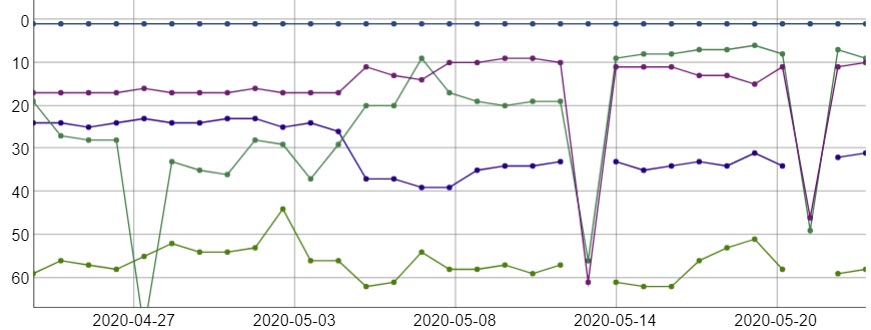
To be able to read the algorithms well you have to have some market sectors and keyword groups you know well. Passively collecting an archive of historical data makes the big changes stand out quickly.
Everyone who depends on SEO to make a living should subscribe to an online rank tracking service or run something like Serposcope locally to track at least a dozen or two dozen keywords. If you track rankings locally it makes sense to use a set of web proxies and run the queries slowly through each so you don't get blocked.
You should track at least a diverse range to get a true sense of the algorithmic changes.
a couple different industries
a couple different geographic markets (or at least some local-intent vs national-intent terms within a country)
some head, midtail and longtail keywords
sites of different size, age & brand awareness within a particular market
Some tools make it easy to quickly add or remove graphing of anything which moved big and is in the top 50 or 100 results, which can help you quickly find outliers. And some tools also make it easy to compare their rankings over time. As updates develop you'll often see multiple sites making big moves at the same time & if you know a lot about the keyword, the market & the sites you can get a good idea of what might have been likely to change to cause those shifts.
Once you see someone mention outliers most people miss that align with what you see in a data set, your level of confidence increases and you can spend more time trying to unravel what signals changed.
I've read influential industry writers mention that links were heavily discounted on this update. I have also read Tweets like this one which could potentially indicate the opposite.
Check out https://t.co/1GhD2U01ch . Up even more than Pinterest and ranking for some real freaky shit.— Paul Macnamara (@TheRealpmac) May 12, 2020
If I had little to no data, I wouldn't be able to get any signal out of that range of opinions. I'd sort of be stuck at "who knows."
By having my own data I track I can quickly figure out which message is more inline with what I saw in my subset of data & form a more solid hypothesis.
No Single Smoking Gun
As Glenn Gabe is fond of saying, sites that tank usually have multiple major issues.
Google rolls out major updates infrequently enough that they can sandwich a couple different aspects into major updates at the same time in order to make it harder to reverse engineer updates. So it does help to read widely with an open mind and imagine what signal shifts could cause the sorts of ranking shifts you are seeing.
Sometimes site level data is more than enough to figure out what changed, but as the above Credit Karma example showed sometimes you need to get far more granular and look at page-level data to form a solid hypothesis.
As the World Changes, the Web Also Changes
About 15 years ago online dating was seen as a weird niche for recluses who perhaps typically repulsed real people in person. Now there are all sorts of niche specialty dating sites including a variety of DTF type apps. What was once weird & absurd had over time become normal.
The COVID-19 scare is going to cause lasting shifts in consumer behavior that accelerate the movement of commerce online. A decade of change will happen in a year or two across many markets.
Tons of offline "value" businesses ended up having no value after months of revenue disappearing while large outstanding debts accumulated interest. There is a belief that some of those brands will have strong latent brand value that carries over online, but if they were weak even when the offline stores acting like interactive billboards subsidized consumer awareness of their brands then as those stores close the consumer awareness & loyalty from in-person interactions will also dry up. A shell of a company rebuilt around the Toys R' Us brand is unlikely to beat out Amazon's parallel offering or a company which still runs stores offline.
There will be waves of bankruptcies, dramatic shifts in commercial real estate prices (already reflected in plunging REIT prices), and more people working remotely (shifting residential real estate demand from the urban core back out into suburbs).
People who work remote are easier to hire and easier to fire. Those who keep leveling up their skills will eventually get rewarded while those who don't will rotate jobs every year or two. The lack of stability will increase demand for education, though much of that incremental demand will be around new technologies and specific sectors - certificates or informal training programs instead of degrees.
More and more activities will become normal online activities.
The University of California has about a half-million students & in the fall semester they are going to try to have most of those classes happen online. How much usage data does Google gain as thousands of institutions put more and more of their infrastructure and service online?
Colleges have to convince students for the next year that a remote education is worth every bit as much as an in-person one, and then pivot back before students actually start believing it.
It’s like only being able to sell your competitor’s product for a year.— Naval (@naval) May 6, 2020
A lot of B & C level schools are going to go under as the like-vs-like comparison gets easier. Back when I ran a membership site here a college paid us to have students gain access to our membership area of the site. As online education gets normalized many unofficial trade-related sites will look more economically attractive on a relative basis.
If core institutions of the state deliver most of their services online, then other companies can be expected to follow. When big cities publish lists of crimes they will not respond to during economic downturns they are effectively subsidizing more crime. That in turn makes moving to somewhere a bit more rural & cheaper make sense, particularly when you no longer need to live near your employer.
The most important implication of this permanent WFH movement are state income taxes.
The warm, sunny states with affordable housing and zero taxes will see an influx of educated, rich workers. States will need to cut taxes to keep up.
The biggest loser in this is CA.— Chamath Palihapitiya (@chamath) May 21, 2020
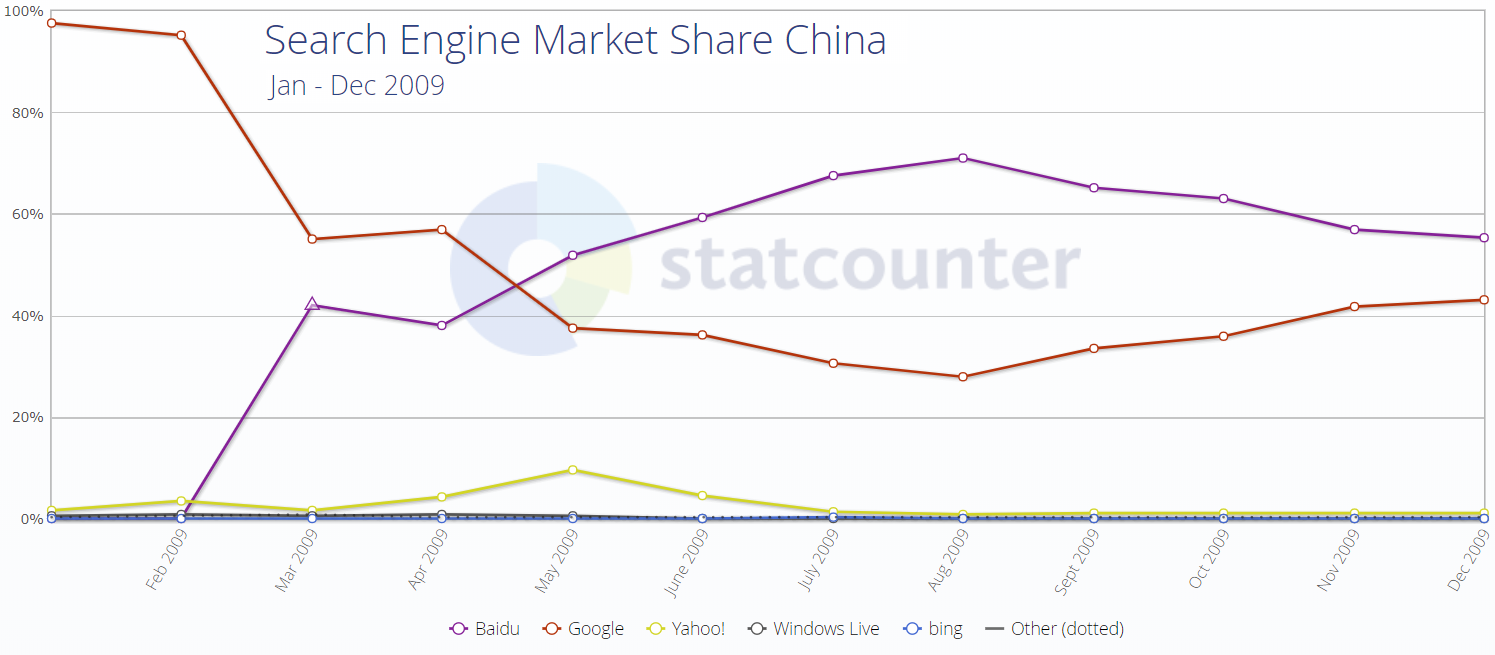
In March of 2010 Google announced they would no longer censor their search results for China:
earlier today we stopped censoring our search services—Google Search, Google News, and Google Images—on Google.cn. Users visiting Google.cn are now being redirected to Google.com.hk, where we are offering uncensored search in simplified Chinese, specifically designed for users in mainland China and delivered via our servers in Hong Kong.
While the move was pitched as altruistic, it came only after the state put their thumb on the scales to promote domestic competitor Baidu in part by periodically blocking Google search from working.
The Value of Leaving China
By leaving China on their own accord, Google controlled the narrative for investors. They didn't "lose" a market, they chose to not operate in a market.
If you are destined to lose due to political interference, you may as well look principled in the process. The idea of staying the course (being highly compromised while also losing) would have lowered Google's leverage (over publishers and governments) as well as their brand value elsewhere.
Think of how long Google has kept the EU at bay in terms of their anti-competitive practices in search.
Countries like France and Australia are just now beginning to require payment to publishers from Google.
In spite of being in fifth place with about 2% search marketshare in China, one could easily argue that today Google is *still* being censored by China, except now it is global.
Official != Legitimate
Whenever there is a crisis Google has the ability to adjust their news algorithms (and rankings on other sources like YouTube) to prefer authoritative sources. If China lies but gives a direct quote that is an official response which can be reported in the media. Speculating, on the other hand, is not news, and thus is not likely to be done at scale on official sources.
The WHO parroted the official line of the Chinese Communist Party for months before sending in a team to begin investigating the virus which was quietly spreading globally in the background. This is evil (or, more charitably, ill-informed) their advice was:
Tedros said there was no need for measures that “unnecessarily interfere with international travel and trade,” and he specifically said that stopping flights and restricting Chinese travel abroad was “counter-productive” to fighting the global spread of the virus.
Evidence is Backward Looking
Promoting "consistent, evidence-based" risk control is utterly stupid because the evidence that you are dead only appears after you die.
It is not a game of 50/50 chance.
One outcome is death. And at the other end of the spectrum you spent $15 needlessly on a facemask.
How lowly must you view the value of a human life to determine a $15 spend on risk mitigation is reckless behavior?
Don't exceed the global standards based on China's misinformation. OR ELSE!!!
WHO can hold countries to account when they needlessly exceed these global standards. This is critical to ensuring the international response is evidence-based, measured & balanced to protect human health in ways that are neither over-reactive nor under-reactive.
Evidence is backward looking even if the sources are not lying scum. When lying is vital to maintaining political power many people die while waiting on the true.
Can anyone who followed official anti-warnings get a refund on their death?
Later, as evidence emerged, we find that closing borders is a great idea - even China does it. Of course early media reports were to not be xenophobic or racist and accept this global problem: "Ultimately some pandemic responses will require opening borders, not closing them. At some point the expectation that any area will escape effects of COVID-19 must be abandoned: The disease must be seen as everyone’s problem."
Later, as evidence emerged, we learn that Taiwan warned the WHO of human to human transmission last December.
‼️WOW‼️ Bruce Aylward/@WHO did an interview with HK's @rthk_news & when asked about #Taiwan he pretended not to hear the question. The journalist asks again & he hangs up!
She calls back & he said "Well, we've already talked about China."
Health officials the world over were guilty of the same sort of "evidence-based" stupidity.
Here is a video from February of NYC health commissioner Dr. Oxiris Barbot advising people to go out and take the subway and live their lives, noting that city preparedness is high, their personal risk is low, and casual contact was not a large risk.
How much of a risk is the new coronavirus to New York City?
You can see the stupidity in the circular logic here: "we also know that if it were likely to be transmitted casually we would be seeing a lot more cases."
“We are very clear: We wish New Yorkers a Happy Lunar New Year and we encourage people to spend time with their families and go about their celebration,” Dr. Barbot said.
Later, as evidence emerged, we learn from serological studies that around 24.7% of people in New York City & 14.9% of New York state had antibodies for the coronavirus that causes COVID-19.
If you are a poor minority you are more likely to die as you have less of a cushion to do things like taking time off work and AVOID TAKING THE SUBWAY.
Thank you Dr. Oxiris Barbot!
"New York politicians are seeking answers on how to handle the growing number of corpses left by the coronavirus pandemic, after dozens of bodies were discovered decomposing in rental trucks outside a Brooklyn funeral home." - Ben Chapman, WSJ
And for a cherry on top of the stupidity cake, New York City only closed their subway system during off hours from 1AM to 5AM for daily cleanings on April 30th, *AFTER* months of letting the virus spread across the city & many blog posts like this one were published. A quarter of their population had to contract the virus before cleaning the subway regularly seemed like a good idea.
just last year, the National Institute for Allergy and Infectious Diseases, the organization led by Dr. Fauci, funded scientists at the Wuhan Institute of Virology and other institutions for work on gain-of-function research on bat coronaviruses . ... Many scientists have criticized gain of function research, which involves manipulating viruses in the lab to explore their potential for infecting humans, because it creates a risk of starting a pandemic from accidental release.
Protecting Yourself from Dr. Oxiris Barbot & the CCP
How many billions of dollars do people spend buying lotto tickets?
A high-quality facemask was a $15 lotto ticket that might save you from death. But buying one was ill-informed & xenophic & antisocial and and and.
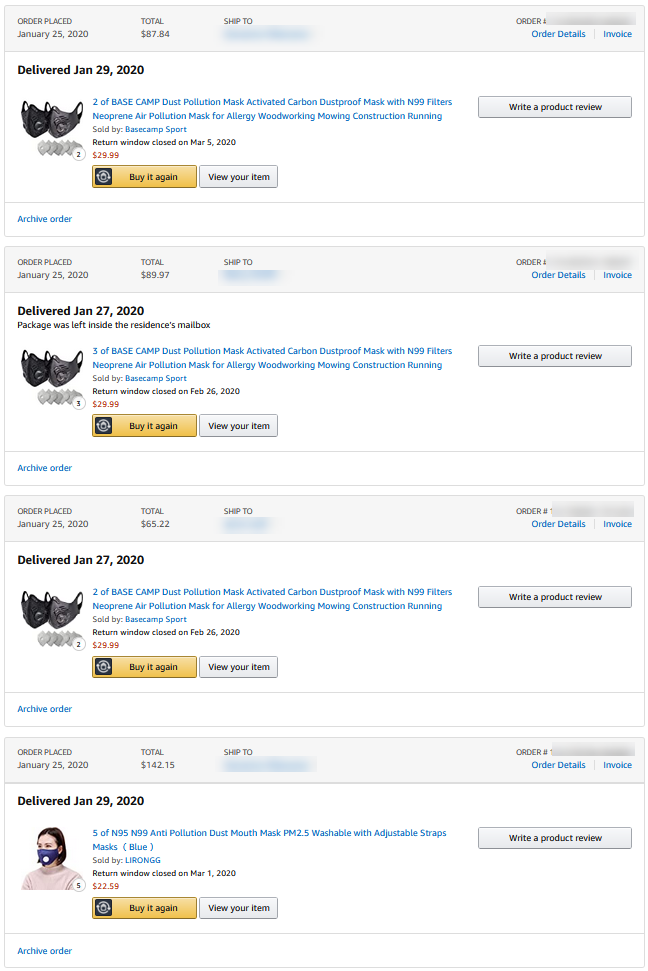
Back in January I saw a video on Twitter of a guy walking down the street in Wuhan and then just fall over and die. Upon seeing that, I quickly ordered facemasks for my wife, our babysitter, my wife's parents, my mom, and my siblings.
My mom thought I was crazy for spending hundreds buying so many masks, but it was a fairly simple calculation. Whatever China was saying was hot garbage as they were literally welding apartment complexes shut.
You can be against the jackbooted CCP while not hating Chinese people. I would rather be wrongly called a racist and not die of coronavirus than virtue signal my way to death via Italy's "Hug a Chinese" day.
As a general rule of thumb, life is more important than the feelz.
My wife took a DNA test and a big part of her ethnic background is Chinese. When she and I are in the Philippines many people think she is a foreigner. When I was walking with my wife in Hong Kong years ago a local street vender started talking to her in Chinese thinking she was a local. And there's nobody in the world I love more than her, but that does not mean she or I are planning a trip to Wuhan anytime soon or wanted to end up as statistics as a side effect of virtue signaling.
To this day China is using their ability to purchase foreign debts & infrastructure across weaker European countries to push the EU to understate the culpability of the CCP:
"Bowing to heavy pressure from Beijing, European Union officials softened their criticism of China this week in a report documenting how governments push disinformation about the coronavirus pandemic, according to documents, emails and interviews. Worried about the repercussions, European officials first delayed and then rewrote the document in ways that diluted the focus on China, a vital trading partner ... China moved quickly to block the document’s release, and the European Union pulled back. The report had been on the verge of publication, until senior officials ordered revisions to soften the language."
Maintaining The Illusion of Stability
The doom scenario for China would be one where the disease spread widely across their society while not directly impacting other economies. Currencies float and trade can eventually be re-routed if supply chains are unreliable. If a place where repeated coronavirus outbreaks happen has massive hidden debts in their shadow economy the propped up currency peg would likely fall as those debts go bad and their economy crashes. Hot money has been rushing out of China for years: their companies buying foreign companies, individuals buying foreign real estate, short domain names, Bitcoin, life insurance policies, etc.
China already faced sharp food price inflation last year as African Swine Flu killed a lot of their herd. When people can't afford to eat they are more likely to push for political change. Hyperinflation is the reciprocal of political stability. Maintaining a stable food supply is a core requirement of staying in power.
Masks might make no difference, but if I spend a fraction of a percent of my income protecting my immediate and extended family even slightly then that is a good investment.
What is the price of a single needless death?
That is the calculation one should use when adopting simple & cheap life changes that can protect their families and society as a whole.
If people would have rushed to buy masks in January it would have sent the market signal to make more. Virtue signaling was considered more important than life.
Instead of any attempts at truth we got communist-fed false assurances to provide the illusion of stability. Lives lack value when compared against maintaining political power:
In 1989, when Chinese citizens raised a Goddess of Democracy on Tiananmen Square, some pinned their hopes on the People’s Liberation Army: Surely the people’s army would never fire on the people. In fact, PLA soldiers proved quite adept at firing on the people. And to this day Beijing refuses to come clean about how many it killed at Tiananmen.
...
Communism has always been far more about Lenin than Marx—that is, about getting and holding power, rather than any economic arrangement. And it’s extraordinary how consistent the lies and violence have been across time and geography, given the many different flavors of communism.
Fake News About Fake News
As China was lying to the world, setting hundreds of thousands of people up for death & destroying the global economy, we suggested the problem was not lies from the CCP or the disease that spread globally in part due to their lies, but rather we should fight "fake news"
The rise of “fake news” - including misinformation and inaccurate advice on social media - could make disease outbreaks such as the COVID-19 coronavirus epidemic currently spreading in China worse, according to research published on Friday.
The lengths to which the WHO went to sacrifice its scientific- and health-related mission for political considerations relating to China were at times both absurd and trivial. For example, in the Coronavirus Q&A that was first posted to its website, the WHO maintained multiple versions. The original English language version of the Q&A counseled that there were four common myths about preventing or curing a COVID-19 infection: smoking, wearing multiple masks, taking antibiotics, and traditional herbal remedies. The original Chinese version omitted ‘traditional herbal remedies’ as a myth. Then the WHO took down ‘traditional herbal remedies’ in both languages. Politics over health. Politics over science. At even the smallest, silliest level.
WHO is also battling misinformation, working with Google to ensure that people get facts from the U.N. health agency first when they search for information about the virus. Social media platforms such as Twitter, Facebook, Tencent and TikTok have also taken steps to limit the spread of misinformation and rumors about the outbreak.
Now that the coronavirus is widespread the idea of keeping the economy perpetually shut down with healthy people quarantined is idiotic & runs counter to science. Those who shelter in place have less exposure to viruses and bacteria from their surrounding environment, which over time leads to weakened immune systems. Add to that all sorts of other issues like: doctors and nurses furloughed while hospitals are idled awaiting a pandemic that never came to most places, economic incentives to misclassify deaths as COVID-19 while ignoring other issues, missing routine treatments that would have diagnosed other health issues that are going undiagnosed for months, loss of job, loss of income, loss of purpose/meaning/ability to provide for family, depression, raging alcoholism, increased domestic violence globally & increased divorce rates in China.
Even the China Uncensored video about the CCP's coverup has a COVID-19 learn more banner redirecting attention back to official sources if you watch the video on YouTube.
Now there are some horrible and ridiculous official statements being made & a whole bunch of crazies spreading "eat aquarium cleaner, protect yourself from COVID-19." I even read a story about a guy who committed suicide because he feared he had COVID-19. All that stuff is horrible, but any and all attempts to defuse those horrible issues & clean them up should come with a note about how the CCP lied broadly, extensively, and is to not be trusted in any way, shape or form.
Where possible, China wants to criminalize any speech … any social media … that does not follow the official party line. Where it’s not possible to criminalize that speech, China wants to ban it through the cooperative censorship of global tech and media platforms. Where it’s not possible to ban that speech, China wants to shame it into the shadows by getting us to reject it as “fake news”.
And if you don’t see that the United States is about two minutes behind China in doing the same damn thing, then you’re just not paying attention.
And while the WHO has tech companies censor "fake news" the CCP releases puppet theatre cartoons about the coronavirus which has killed hundreds of thousands of people.
Yes that video is real. And yes, they really are that scummy.
The puppet theatre video makes no mention of police going after doctors for mentioning the virus, Taiwan reporting the virus to the WHO, the WHO ignoring Taiwan, internal briefings to Xi while the public was left in the dark, or any of the other disconnects between inside and outside voices.
The CCP disinformation campaign is widespread. They buy ads for content use cute animals to promote their absolute propaganda:
Anything that diminishes the power and prestige of the CCP is worse than death:
The biggest threat facing the U.S. is not the new virus, but rather right-wing populists who are intent on creating trouble with their strain of political virus.
The above statement only serves to confirm the following:
Communism has always been far more about Lenin than Marx—that is, about getting and holding power, rather than any economic arrangement. And it’s extraordinary how consistent the lies and violence have been across time and geography, given the many different flavors of communism.
Luckily China does not have a monopoly on political cartoons and they have not yet managed to classify the following as some form of fake news or hate speech to be censored.
"This is the Chinese Communist Party, with their callousness, their deceitfulness, their inhumanity, and their disregard for any values. This has come to the forefront. That’s what this pandemic has done. It has exposed to the world exactly who they are, what they are, what they will do and what means they will use to get to the ends they want. ... [China's lap dogs are] a combination of the city of London and Wall Street and global corporatists, and even certain media outlets. ... They knew they had community spread no later than the third or fourth week of December 2019. They prosecuted many of the heroes of Wuhan who tried to get word out to their fellow citizens. As you know, they prosecuted Dr. Li [Wenliang, the early whistleblower who died of Covid-19 at the age of 33] and other heroes. And they made them sign rumor mongering confessions, which is one of the worst things you can do in China. ... The University of Southampton in the United Kingdom did a study that showed that had they just come forward in the last week of December or the first week of January and admitted that they had human-to-human transmission and community spread that 95 percent of the the deaths, 95 percent of the agony, 95 percent of the economic destruction could have all been avoided. ... they were hiding things. They wanted to make sure that nothing came up before they signed the trade deal [January 15, 2020]. They wanted to make sure nothing exposed them during Davos [January 21-24, 2020], where they had organized their biggest contingent ever to Davos. But if Lunar New Year had not been in those weeks, if this had happened in, let’s say, in October or November, we have no earthly idea how long they would have tried to suppress this. ... We now know that Xi Jinping took personal responsibility starting on January 6 or 7. We know that the World Health Organization put out its press release on the 9th. Then the tweet on the 14th said that after consultation with China’s Ministry of Health that there is no human-to-human transmission or community spreading. That’s all a lie. We also know they [China] restricted travel shortly thereafter, or in China domestically. But they did not stop traveling throughout the world, particularly to Europe and the United States. ... They’re engaged in economic warfare." - Steve Bannon
My thesis was Google would need to increasingly promote some smaller niche sites to make general web search differentiated from other web channels & minimize the market power of vertical leading providers.
The reason my thesis was only half correct (and ultimately led to the absolutely wrong conclusion) is Google has the ability to provide the illusion of diversity while using sort of eye candy displacement efforts to shift an increasing share of searches from organic to paid results.
Shallow Verticals With a Shill Bid
As long as any market has at least 2 competitors in it Google can create a "me too" offering that they hard code front & center and force the other 2 players (along with other players along the value chain) to bid for marketshare. If competitors are likely to complain about the thinness of the me too offering & it being built upon scraping other websites, Google can buy out a brand like Zagat or a data supplier like ITA Software to undermine criticism until the artificially promoted vertical service has enough usage that it is nearly on par with other players in the ecosystem.
Google need not win every market. They only need to ensure there are at least 2 competing bids left in the marketplace while dialing back SEO exposure. They can then run other services to redirect user flow and force the ad buy. They can insert their own bid as a sort of shill floor bid in their auction. If you bid below that amount they'll collect the profit through serving the customer directly, if you bid above that they'll let you buy the customer vs doing a direct booking.
Adding Volatility to Economies of Scale
Where this gets more than a bit tricky is if you are a supplier of third party goods & services where you buy in bulk to get preferential pricing for resale. If you buy 100 rooms a night from a particular hotel based on the presumption of prior market performance & certain channels effectively disappear you have to bid above market to sell some portion of the rooms because getting anything for them is better than leaving them unsold.
"Well I am not in hotels, so thankfully this won't impact me" is an incomplete thought. Google Ads now offer a lead generation extension.
When a vertical is new a player can compete just by showing up. Then over time as the verticals become established consumers develop habits, brands beat out generics & the markets get consolidated down to being heavily influenced & controlled by a couple strong players.
In the offline world of atoms there are real world costs tied to local regulations, shipping, sourcing, supply chains, inventory management, etc. The structure of the web & the lack of marginal distribution cost causes online markets to be even more consolidated than their offline analogs.
When Travelocity outsourced their backend infrastructure to Expedia most people visiting their website were unaware of the change. After Expedia acquired the site, longtime Travelocity customers likely remained unaware. In some businesses the only significant difference in the user experience is the logo at the top of the page.
Most large markets will ultimately consolidate down to a couple players (e.g. Booking vs Expedia) while smaller players lack the scale needed to have the economic leverage to pay Google's increasing rents.
This sort of consolidation was happening even when the search results were mostly organic & relevancy was driven primarily by links. As Google has folded in usage data & increased ad load on the search results it becomes harder for a generically descriptive domain name to build brand-related signals.
Re-sorting the Markets Once More
It is not only generically descriptive sorts of sites that have faded though. Many brand investments turned out to be money losers after the search result set was displaced by more ads (& many brand-related search result pages also carry ads above the organic results).
Since the Motorola debacle, it was Google's largest acquisition after the $676 million purchase of ITA Software, which became Google Flights. (Uh, remember that? Does anyone use that instead of Travelocity or one of the many others? Neither do I.)
The reality is brands lose value as the organic result set is displaced. To make the margins work they might desperately outsource just about everything but marketing to a competitor / partner, which will then latter acquire them for a song.
Travelocity had roughly 3,000 people on the payroll globally as recently as a couple of years ago, but the Travelocity workforce has been whittled to around 50 employees in North America with many based in the Dallas area.
The best relevancy algorithm in the world is trumped by preferential placement of inferior results which bypasses the algorithm. If inferior results are hard coded in placements which violate net neutrality for an extended period of time, they can starve other players in the market from the vital user data & revenues needed to reinvest into growth and differentiation.
Value plays see their stocks crash as growth slows or goes in reverse. With the exception of startups funded by Softbank, growth plays are locked out of receiving further investment rounds as their growth rate slides.
Startups like Hipmunk disappear. Even an Orbitz or Travelocity become bolt on acquisitions.
The viability of TripAdvisor as a stand alone business becomes questioned, leading them to partner with Ctrip.
TripAdvisor has one of the best link profiles of any commercially oriented website outside of perhaps Amazon.com. But ranking #1 doesn't count for much if that #1 ranking is below the fold. Or, even worse, if Google literally hides the organic search results.
TripAdvisor shifted their business model to allow direct booking to better monetize mobile web users, but as Google has ate screen real estate and grew Google Travel into a $100 billion business other players have seen their stocks sag.
Top of The Funnel
Google sits at the top of the funnel & all other parts of the value chain are compliments to be commoditized.
Buy premium domain names? Google's SERPs test replacing domain names with words & make the words associated with the domain name gray.
Improve conversion rates? Your competitor almost certainly did as well, now you both can bid more & hand over an increasing economic rent to Google.
Invest in brand awareness? Google shows ads for competitors on your brand terms, forcing you to buy to protect the brand equity you paid to build.
Search Metrics mentioned Hotels.com was one of the biggest losers during the recent algorithm updates: "I’m going to keep on this same theme there, and I’m not going to say overall numbers, the biggest loser, but for my loser I’m going to pick Hotels.com, because they were literally like neck and neck, like one and two with Booking, as far as how close together they were, and the last four weeks, they’ve really increased that separation."
As Google ate the travel category the value of hotel-related domain names has fallen through the floor.
Most of the top selling hotel-related domain names were sold about a decade ago:
On August 8th HongKongHotels.com sold for $4,038. A decade ago that name likely would have sold for around $100,000.
And the new buyer may have overpaid for it!
Growing Faster Than the Market
Google consistently grows their ad revenues 20% a year in a global economy growing at under 4%.
There are only about 6 ways they can do that
growth of web usage (though many of those who are getting online today have a far lower disposable income than those who got on a decade or two ago did)
gain marketshare (very hard in search, given that they effectively are the market in most markets outside of a few countries like China & Russia)
create new inventory (new ad types on image search results, Google Maps & YouTube)
charge more for clicks
improve at targeting through better surveillance of web users (getting harder after GDPR & similar efforts from some states in the next year or two)
shift click streams away from organic toward paid channels (through larger ads, more interactive ad units, less appealing organic result formatting, pushing organic results below the fold, hiding organic results, etc.)
Six of One, Half-dozen of the Other
Wednesday both Expedia and TripAdvisor reported earnings after hours & both fell off a cliff: "Both Okerstrom and Kaufer complained that their organic, or free, links are ending up further down the page in Google search results as Google prioritizes its own travel businesses."
Losing 20% to 25% of your market cap in a single day is an extreme move for a company worth billions of dollars.
Thursday Google hit fresh all time highs.
"Google’s old motto was ‘Don’t Be Evil’, but you can’t be this big and profitable and not be evil. Evil and all-time highs pretty much go hand in hand." - Howard Lindzon
Booking held up much better than TripAdvisor & Expedia as they have a bigger footprint in Europe (where antitrust is a thing) and they have a higher reliance on paid search versus organic.
Frozen in Fear vs Fearless
The broader SEO industry is to some degree frozen by fear. Roughly half of SEOs claim to have not bought *ANY* links in a half-decade.
Anonymous survey: have you (or your company) purchased backlinks - of ANY quality - for your own site, or any of your clients' sites, at any point in the past ~5 years?— Lily Ray (@lilyraynyc) October 24, 2019
Long after most of the industry has stopped buying links some people still run the "paid links are a potential FTC violation guideline" line as though it is insightful and/or useful.
Some people may be violating FTC rules by purchasing links that are not labeled as sponsored. This includes "content marketers" who publish articles with paid links on sites they curate.
It's a ticking time bomb because it's illegal.— Roger Montti (@martinibuster) October 24, 2019
Does small gray text in the upper right corner stating "about these results" count as legitimate ad labeling?
And then when you scroll over that gray text and click on it you get "Some of these hotel search results may be personalized based on your browsing activity and recent searches on Google, as well as travel confirmations sent to your Gmail. Hotel prices come from Google's partners."
Ads, Scroll, Ads, Scroll, Ads...
Zooming out a bit further on the above ad unit to look at the entire search result page, we can now see the following:
4 text ad units above the map
huge map which segments demand by price tier, current sales, luxury, average review, geographic location
organic results below the above wall of ads, and the number of organic search results has been reduced from 10 to 7
How many scrolls does one need to do to get past the above wall of ads?
If one clicks on one of the hotel prices the follow up page is ... more ads.
Check out how the ad label is visually overwhelmed by a bright blue pop over.
Defund
It is worth noting Google Chrome has a built-in ad blocking feature which allows them to strip all ads from displaying on third party websites if they follow Google's best practices layout used in the search results.
You won't see ads on websites that have poor ad experiences, like:
Too many ads
Annoying ads with flashing graphics or autoplaying audio
Ad walls before you can see content
When these ads are blocked, you'll see an "Intrusive ads blocked" message. Intrusive ads will be removed from the page.
Hotels have been at the forefront of SEO for many years. They drive massive revenues & were perhaps the only vertical ever referenced in the Google rater guidelines which explicitly stated all affiliate sites should be labeled as spam even if they are helpful to users.
Zoopla, Rightmove and On The Market are all dominant players in the industry, and many of their house and apartment listings are duplicated across the different property portals. This represents a very real reason for Google to step in and create a more streamlined service that will help users make a more informed decision. ... The launch of Google Jobs should not have come as a surprise to anyone, and neither should its potential foray into real estate. Google will want to diversify its revenue channels as much as possible, and any market that allows it to do so will be in its sights. It is no longer a matter of if they succeed, but when.
If nobody is serving a market that is justification for entering it. If a market has many diverse players that is justification for entering it. If a market is dominated by a few strong players that is justification for entering it. All roads lead to the pile of money. :)
Extracting information from the ecosystem & diverting attention from other players while charging rising rents does not make the ecosystem stronger. Doing so does not help users make a more informed decision.
"Nexstar Media Group Inc., the largest local news company in the U.S., recently tested what would happen if it stopped using Google’s technology to place ads on its websites. Over several days, the company’s video ad sales plummeted. “That’s a huge revenue hit,” said Tony Katsur, senior vice president at Nexstar. After its brief test, Nexstar switched back to Google." ... "Regulators who approved that $3.1 billion deal warned they would step in if the company tied together its offerings in anticompetitive ways. In interviews, dozens of publishing and advertising executives said Google is doing just that with an array of interwoven products."
there’s some nuance in this new drama — one of many to come from the past decade’s conversion of news companies into financial instruments stripped of civic responsibility by waves of outside money men. After all, when we talk about newspaper companies, we typically use their corporate names — Gannett, GateHouse, McClatchy, MNG, Lee. But it’s at least as appropriate to use the names of the hedge funds, private equity companies, and other investment vehicles that own and control them.
The Washington Post - owned by Amazon's Jeff Bezos - is creating an ad tech stack which serves other publishers & brands, though they also believe a reliance on advertiser & subscription revenue is unsustainable: “We are too beholden to just advertiser and subscriber revenue, and we’re completely out of our minds if we think that’s what’s going to be what carries us through the next generation of publishing. That’s very clear.”
Future Prospects
We are nearing inflection points in many markets where markets that seemed somewhat disconnected from search will still end up being dominated by Google. Gmail, Android, Web Analytics, Play Store, YouTube, Maps, Waze ... are all additional points of leverage beyond the core search & ads products.
If all roads lead to money one can't skip healthcare - now roughly 20% of the United States GDP.
Google is investing heavily in quantum computing. Google Fiber was a nothingburger to force competing ISPs into accelerating expensive network upgrades, but beaming in internet services from satellites will allow Google to bypass local politics, local regulations & heavy network infrastructure construction costs. A startup named Kepler recently provided high-bandwidth connectivity to the Arctic. When Google launches a free ISP there will be many knock on effects causing partners to long for the day where Google was only as predatory as they are today.
"Capitalism is an efficient system for surfacing and addressing the needs of consumers. But once it veers toward control over markets by a single entity, those benefits disappear." - Seth Godin
Last month Google announced they were going to change how they treated nofollow, moving it from a directive toward a hint. As part of that they also announced the release of parallel attributes rel="sponsored" for sponsored links & rel="ugc" for user generated content in areas like forums & blog comments.
Why not completely ignore such links, as had been the case with nofollow? Links contain valuable information that can help us improve search, such as how the words within links describe content they point at. Looking at all the links we encounter can also help us better understand unnatural linking patterns. By shifting to a hint model, we no longer lose this important information, while still allowing site owners to indicate that some links shouldn’t be given the weight of a first-party endorsement.
In many emerging markets the mobile web is effectively the entire web. Few people create HTML links on the mobile web outside of on social networks where links are typically nofollow by default. This reduces the potential signal available to either tracking what people do directly and/or shifting how the nofollow attribute is treated.
Google shifting how nofollow is treated is a blanket admission that Penguin & other elements of "the war on links" were perhaps a bit too effective and have started to take valuable signals away from Google.
Google has suggested the shift in how nofollow is treated will not lead to any additional blog comment spam. When they announced nofollow they suggested it would lower blog comment spam. Blog comment spam remains a growth market long after the gravity of the web has shifted away from blogs onto social networks.
Changing how nofollow is treated only makes any sort of external link analysis that much harder. Those who specialize in link audits (yuck!) have historically ignored nofollow links, but now that is one more set of things to look through. And the good news for professional link auditors is that increases the effective cost they can charge clients for the service.
Some nefarious types will notice when competitors get penalized & then fire up Xrummer to help promote the penalized site, ensuring that the link auditor bankrupts the competing business even faster than Google.
If, like most people, you thought Google stopped tracking your location once you turned off Location History in your account settings, you were wrong. According to an AP investigation published Monday, even if you disable Location History, the search giant still tracks you every time you open Google Maps, get certain automatic weather updates, or search for things in your browser.
The reason that PageRank is interesting is that there are many cases where simple citation counting does not correspond to our common sense notion of importance. For example, if a web page has a link on the Yahoo home page, it may be just one link but it is a very important one. This page should be ranked higher than many pages with more links but from obscure places. PageRank is an attempt to see how good an approximation to "importance" can be obtained just from the link structure. ... The denition of PageRank above has another intuitive basis in random walks on graphs. The simplied version corresponds to the standing probability distribution of a random walk on the graph of the Web. Intuitively, this can be thought of as modeling the behavior of a "random surfer".
Google's reliance on links turned links into a commodity, which led to all sorts of fearmongering, manual penalties, nofollow and the Penguin update.
As Google collected more usage data those who overly focused on links often ended up scoring an own goal, creating sites which would not rank.
Google no longer invests heavily in fearmongering because it is no longer needed. Search is so complex most people can't figure it out.
Many SEOs have reduced their link building efforts as Google dialed up weighting on user engagement metrics, though it appears the tide may now be heading in the other direction. Some sites which had decent engagement metrics but little in the way of link building slid on the update late last month.
As much as Google desires relevancy in the short term, they also prefer a system complex enough to external onlookers that reverse engineering feels impossible. If they discourage investment in SEO they increase AdWords growth while gaining greater control over algorithmic relevancy.
Google will soon collect even more usage data by routing Chrome users through their DNS service: "Google isn't actually forcing Chrome users to only use Google's DNS service, and so it is not centralizing the data. Google is instead configuring Chrome to use DoH connections by default if a user's DNS service supports it."
If traffic is routed through Google that is akin to them hosting the page in terms of being able to track many aspects of user behavior. It is akin to AMP or YouTube in terms of being able to track users and normalize relative engagement metrics.
Once Google is hosting the end-to-end user experience they can create a near infinite number of ranking signals given their advancement in computing power: "We developed a new 54-qubit processor, named “Sycamore”, that is comprised of fast, high-fidelity quantum logic gates, in order to perform the benchmark testing. Our machine performed the target computation in 200 seconds, and from measurements in our experiment we determined that it would take the world’s fastest supercomputer 10,000 years to produce a similar output."
Relying on "one simple trick to..." sorts of approaches are frequently going to come up empty.
Google's mobile layout, which they are now testing on desktop computers as well, replaces green domain names with gray words which are easy to miss. And the favicon icons sort of make the organic results look like ads. Any boost a domain name like CreditCards.ext might have garnered in the past due to matching the keyword has certainly gone away with this new layout that further depreciates the impact of exact-match domain names.
At one point in time CreditCards.com was viewed as a consumer destination. It is now viewed ... below the fold.
If you have a memorable brand-oriented domain name the favicon can help offset the above impact somewhat, but matching keywords is becoming a much more precarious approach to sustaining rankings as the weight on brand awareness, user engagement & authority increase relative to the weight on anchor text.
Beyond search Google controls the leading distributed ad network, the leading mobile OS, the leading web browser, the leading email client, the leading web analytics platform, the leading mapping platform, the leading free video hosting site.
They win a lot.
And they take winnings from one market & leverage them into manipulating adjacent markets.
Embrace. Extend. Extinguish.
Imagine taking a universal open standard that has zero problems with it and then stripping it down to it's most basic components and then prepending each element with your own acronym. Then spend years building and recreating what has existed for decades. That is @amphtml— Jon Henshaw (@henshaw) April 4, 2019
AMP is an utterly unnecessary invention designed to further shift power to Google while disenfranchising publishers. From the very start it had many issues with basic things like supporting JavaScript, double counting unique users (no reason to fix broken stats if they drive adoption!), not supporting third party ad networks, not showing publisher domain names, and just generally being a useless layer of sunk cost technical overhead that provides literally no real value.
Over time they have corrected some of these catastrophic deficiencies, but if it provided real value, they wouldn't have needed to force adoption with preferential placement in their search results. They force the bundling because AMP sucks.
Absurdity knows no bounds. Googlers suggest: "AMP isn’t another “channel” or “format” that’s somehow not the web. It’s not a SEO thing. It’s not a replacement for HTML. It’s a web component framework that can power your whole site. ... We, the AMP team, want AMP to become a natural choice for modern web development of content websites, and for you to choose AMP as framework because it genuinely makes you more productive."
The AMP development team now keeps track of whether AMP traffic drops suddenly, which might indicate pages are invalid, and it can react quickly.
All this adds expense, though. There are setup, development and maintenance costs associated with AMP, mostly in the form of time. After implementing AMP, the Guardian realized the project needed dedicated staff, so it created an 11-person team that works on AMP and other aspects of the site, drawing mostly from existing staff.
Feeeeeel the productivity!
Some content types (particularly user generated content) can be unpredictable & circuitous. For many years forums websites would use keywords embedded in the search referral to highlight relevant parts of the page. Keyword (not provided) largely destroyed that & then it became a competitive feature for AMP: "If the Featured Snippet links to an AMP article, Google will sometimes automatically scroll users to that section and highlight the answer in orange."
That would perhaps be a single area where AMP was more efficient than the alternative. But it is only so because Google destroyed the alternative by stripping keyword referrers from search queries.
"I see them as part of the effort to normalise the use of the AMP Carousel, which is an anti-competitive land-grab for the web by an organisation that seems to have an insatiable appetite for consuming the web, probably ultimately to it’s own detriment. ... This enables Google to continue to exist after the destination site (eg the New York Times) has been navigated to. Essentially it flips the parent-child relationship to be the other way around. ... As soon as a publisher blesses a piece of content by packaging it (they have to opt in to this, but see coercion below), they totally lose control of its distribution. ... I’m not that smart, so it’s surely possible to figure out other ways of making a preload possible without cutting off the content creator from the people consuming their content. ... The web is open and decentralised. We spend a lot of time valuing the first of these concepts, but almost none trying to defend the second. Google knows, perhaps better than anyone, how being in control of the user is the most monetisable position, and having the deepest pockets and the most powerful platform to do so, they have very successfully inserted themselves into my relationship with millions of other websites. ... In AMP, the support for paywalls is based on a recommendation that the premium content be included in the source of the page regardless of the user’s authorisation state. ... These policies demonstrate contempt for others’ right to freely operate their businesses.
After enough publishers adopted AMP Google was able to turn their mobile app's homepage into an interactive news feed below the search box. And inside that news feed Google gets to distribute MOAR ads while 0% of the revenue from those ads find its way to the publishers whose content is used to make up the feed.
Appropriate appropriation. :D
Thank you for your content!!!
Well this issue (bug?) is going to cause a sh*t storm...
Google @AMPhtml not allowing people to click through to full site? You can’t see but am clicking the link in top right
European and American tech, media and publishing companies, including some that originally embraced AMP, are complaining that the Google-backed technology, which loads article pages in the blink of an eye on smartphones, is cementing the search giant's dominance on the mobile web.
Each additional layer of technical cruft is another cost center. Things that sound appealing at first blush may not be:
The way you verify your identity to Let's Encrypt is the same as with other certificate authorities: you don't really. You place a file somewhere on your website, and they access that file over plain HTTP to verify that you own the website. The one attack that signed certificates are meant to prevent is a man-in-the-middle attack. But if someone is able to perform a man-in-the-middle attack against your website, then he can intercept the certificate verification, too. In other words, Let's Encrypt certificates don't stop the one thing they're supposed to stop. And, as always with the certificate authorities, a thousand murderous theocracies, advertising companies, and international spy organizations are allowed to impersonate you by design.
Anything that is easy to implement & widely marketed often has costs added to it in the future as the entity moves to monetize the service.
This is a private equity firm buying up multiple hosting control panels & then adjusting prices.
This is Google Maps drastically changing their API terms.
This is Facebook charging you for likes to build an audience, giving your competitors access to those likes as an addressable audience to advertise against, and then charging you once more to boost the reach of your posts.
Shivane believes GrubHub purchased her restaurant’s web domain to prevent her from building her own online presence. She also believes the company may have had a special interest in owning her name because she processes a high volume of orders. ... it appears GrubHub has set up several generic, templated pages that look like real restaurant websites but in fact link only to GrubHub. These pages also display phone numbers that GrubHub controls. The calls are forwarded to the restaurant, but the platform records each one and charges the restaurant a commission fee for every order
Settling for the easiest option drives a lack of differentiation, embeds additional risk & once the dominant player has enough marketshare they'll change the terms on you.
Small gains in short term margins for massive increases in fragility.
"Closed platforms increase the chunk size of competition & increase the cost of market entry, so people who have good ideas, it is a lot more expensive for their productivity to be monetized. They also don't like standardization ... it looks like rent seeking behaviors on top of friction" - Gabe Newell
Those who look at SaaS business models through the eyes of a seasoned investor will better understand how markets are likely to change:
"I’d argue that many of today’s anointed tech “disruptors” are doing little in the way of true disruption. ... When investors used to get excited about a SAAS company, they typically would be describing a hosted multi-tenant subscription-billed piece of software that was replacing a ‘legacy’ on-premise perpetual license solution in the same target market (i.e. ERP, HCM, CRM, etc.). Today, the terms SAAS and Cloud essentially describe the business models of every single public software company.
Most platform companies are initially required to operate at low margins in order to buy growth of their category & own their category. Then when they are valued on that, they quickly need to jump across to adjacent markets to grow into the valuation:
Twilio has no choice but to climb up the application stack. This is a company whose ‘disruption’ is essentially great API documentation and gangbuster SEO spend built on top of a highly commoditized telephony aggregation API. They have won by marketing to DevOps engineers. With all the hype around them, you’d think Twilio invented the telephony API, when in reality what they did was turn it into a product company. Nobody had thought of doing this let alone that this could turn into a $17 billion company because simply put the economics don’t work. And to be clear they still don’t. But Twilio’s genius CEO clearly gets this. If the market is going to value robocalls, emergency sms notifications, on-call pages, and carrier fee passed through related revenue growth in the same way it does ‘subscription’ revenue from Atlassian or ServiceNow, then take advantage of it while it lasts.
Large platforms offering temporary subsidies to ensure they dominate their categories & companies like SoftBank spraying capital across the markets is causing massive shifts in valuations:
I also think if you look closely at what is celebrated today as innovation you often find models built on hidden subsidies. ... I’d argue the very distributed nature of microservices architecture and API-first product companies means addressable market sizes and unit economics assumptions should be even more carefully scrutinized. ... How hard would it be to create an Alibaba today if someone like SoftBank was raining money into such a greenfield space? Excess capital would lead to destruction and likely subpar returns. If capital was the solution, the 1.5 trillion that went into telcos in late '90s wouldn’t have led to a massive bust. Would a Netflix be what it is today if a SoftBank was pouring billions into streaming content startups right as the experiment was starting? Obviously not. Scarcity of capital is another often underappreciated part of the disruption equation. Knowing resources are finite leads to more robust models. ... This convergence is starting to manifest itself in performance. Disney is up 30% over the last 12 months while Netflix is basically flat. This may not feel like a bubble sign to most investors, but from my standpoint, it’s a clear evidence of the fact that we are approaching a something has got to give moment for the way certain businesses are valued."
Circling back to Google's AMP, it has a cousin called Recaptcha.
According to tech statistics website Built With, more than 650,000 websites are already using reCaptcha v3; overall, there are at least 4.5 million websites use reCaptcha, including 25% of the top 10,000 sites. Google is also now testing an enterprise version of reCaptcha v3, where Google creates a customized reCaptcha for enterprises that are looking for more granular data about users’ risk levels to protect their site algorithms from malicious users and bots. ... According to two security researchers who’ve studied reCaptcha, one of the ways that Google determines whether you’re a malicious user or not is whether you already have a Google cookie installed on your browser. ... To make this risk-score system work accurately, website administrators are supposed to embed reCaptcha v3 code on all of the pages of their website, not just on forms or log-in pages.
About a month ago when logging into Bing Ads I saw recaptcha on the login page & couldn't believe they'd give Google control at that access point. I think they got rid of that, but lots of companies are perhaps shooting themselves in the foot through a combination of over-reliance on Google infrastructure AND sloppy implementation
Today when making a purchase on Fiverr, after converting, I got some of this action
Hmm. Maybe I will enable JavaScript and try again.
Oooops.
That is called snatching defeat from the jaws of victory.
My account is many years old. My payment type on record has been used for years. I have ordered from the particular seller about a dozen times over the years. And suddenly because my web browser had JavaScript turned off I was deemed a security risk of some sort for making an utterly ordinary transaction I have already completed about a dozen times.
On AMP JavaScript was the devil. And on desktop not JavaScript was the devil.
Pro tip: Ecommerce websites that see substandard conversion rates from using Recaptcha can boost their overall ecommerce revenue by buying more Google AdWords ads.
---
As more of the infrastructure stack is driven by AI software there is going to be a very real opportunity for many people to become deplatformed across the web on an utterly arbitrary basis. That tech companies like Facebook also want to create digital currencies on top of the leverage they already have only makes the proposition that much scarier.
If the tech platforms host copies of our sites, process the transactions & even create their own currencies, how will we know what level of value they are adding versus what they are extracting?
Who measures the measurer?
And when the economics turn negative, what will we do if we are hooked into an ecosystem we can't spend additional capital to get out of when things head south?
It has been a while since Google has had a major algorithm update.
They recently announced one which began on the 12th of March.
This week, we released a broad core algorithm update, as we do several times per year. Our guidance about such updates remains as we’ve covered before. Please see these tweets for more about that:https://t.co/uPlEdSLHoXhttps://t.co/tmfQkhdjPL— Google SearchLiaison (@searchliaison) March 13, 2019
And, over time, it was quite common for Panda & Penguin updates to be sandwiched together.
If you were Google & had the ability to look under the hood to see why things changed, you would probably want to obfuscate any major update by changing multiple things at once to make reverse engineering the change much harder.
Anyone who operates a single website (& lacks the ability to look under the hood) will have almost no clue about what changed or how to adjust with the algorithms.
In the most recent algorithm update some sites which were penalized in prior "quality" updates have recovered.
Though many of those recoveries are only partial.
Many SEO blogs will publish articles about how they cracked the code on the latest update by publishing charts like the first one without publishing that second chart showing the broader context.
The first penalty any website receives might be the first of a series of penalties.
If Google smokes your site & it does not cause a PR incident & nobody really cares that you are gone, then there is a very good chance things will go from bad to worse to worser to worsterest, technically speaking.
“In this age, in this country, public sentiment is everything. With it, nothing can fail; against it, nothing can succeed. Whoever molds public sentiment goes deeper than he who enacts statutes, or pronounces judicial decisions.” - Abraham Lincoln
Absent effort & investment to evolve FASTER than the broader web, sites which are hit with one penalty will often further accumulate other penalties. It is like compound interest working in reverse - a pile of algorithmic debt which must be dug out of before the bleeding stops.
Further, many recoveries may be nothing more than a fleeting invitation to false hope. To pour more resources into a site that is struggling in an apparent death loop.
The above site which had its first positive algorithmic response in a couple years achieved that in part by heavily de-monetizing. After the algorithm updates already demonetized the website over 90%, what harm was there in removing 90% of what remained to see how it would react? So now it will get more traffic (at least for a while) but then what exactly is the traffic worth to a site that has no revenue engine tied to it?
That is ultimately the hard part. Obtaining a stable stream of traffic while monetizing at a decent yield, without the monetizing efforts leading to the traffic disappearing.
A buddy who owns the above site was working on link cleanup & content improvement on & off for about a half year with no results. Each month was a little worse than the prior month. It was only after I told him to remove the aggressive ads a few months back that he likely had any chance of seeing any sort of traffic recovery. Now he at least has a pulse of traffic & can look into lighter touch means of monetization.
If a site is consistently penalized then the problem might not be an algorithmic false positive, but rather the business model of the site.
The more something looks like eHow the more fickle Google's algorithmic with receive it.
Google does not like websites that sit at the end of the value chain & extract profits without having to bear far greater risk & expense earlier into the cycle.
Thin rewrites, largely speaking, don't add value to the ecosystem. Doorway pages don't either. And something that was propped up by a bunch of keyword-rich low-quality links is (in most cases) probably genuinely lacking in some other aspect.
Generally speaking, Google would like themselves to be the entity at the end of the value chain extracting excess profits from markets.
This is the purpose of the knowledge graph & featured snippets. To allow the results to answer the most basic queries without third party publishers getting anything. The knowledge graph serve as a floating vertical that eat an increasing share of the value chain & force publishers to move higher up the funnel & publish more differentiated content.
As Google adds features to the search results (flight price trends, a hotel booking service on the day AirBNB announced they acquired HotelTonight, ecommerce product purchase on Google, shoppable image ads just ahead of the Pinterest IPO, etc.) it forces other players in the value chain to consolidate (Expedia owns Orbitz, Travelocity, Hotwire & a bunch of other sites) or add greater value to remain a differentiated & sought after destination (travel review site TripAdvisor was crushed by the shift to mobile & the inability to monetize mobile traffic, so they eventually had to shift away from being exclusively a reviews site to offer event & hotel booking features to remain relevant).
It is never easy changing a successful & profitable business model, but it is even harder to intentionally reduce revenues further or spend aggressively to improve quality AFTER income has fallen 50% or more.
Some people do the opposite & make up for a revenue shortfall by publishing more lower end content at an ever faster rate and/or increasing ad load. Either of which typically makes their user engagement metrics worse while making their site less differentiated & more likely to receive additional bonus penalties to drive traffic even lower.
In some ways I think the ability for a site to survive & remain though a penalty is itself a quality signal for Google.
Some sites which are overly reliant on search & have no external sources of traffic are ultimately sites which tried to behave too similarly to the monopoly that ultimately displaced them. And over time the tech monopolies are growing more powerful as the ecosystem around them burns down:
If you had to choose a date for when the internet died, it would be in the year 2014. Before then, traffic to websites came from many sources, and the web was a lively ecosystem. But beginning in 2014, more than half of all traffic began coming from just two sources: Facebook and Google. Today, over 70 percent of traffic is dominated by those two platforms.
Businesses which have sustainable profit margins & slack (in terms of management time & resources to deploy) can better cope with algorithmic changes & change with the market.
Over the past half decade or so there have been multiple changes that drastically shifted the online publishing landscape:
the shift to mobile, which both offers publishers lower ad yields while making the central ad networks more ad heavy in a way that reduces traffic to third party sites
the rise of the knowledge graph & featured snippets which often mean publishers remain uncompensated for their work
higher ad loads which also lower organic reach (on both search & social channels)
the rise of programmatic advertising, which further gutted display ad CPMs
the rise of ad blockers
increasing algorithmic uncertainty & a higher barrier to entry
Each one of the above could take a double digit percent out of a site's revenues, particularly if a site was reliant on display ads. Add them together and a website which was not even algorithmically penalized could still see a 60%+ decline in revenues. Mix in a penalty and that decline can chop a zero or two off the total revenues.
Businesses with lower margins can try to offset declines with increased ad spending, but that only works if you are not in a market with 2 & 20 VC fueled competition:
Startups spend almost 40 cents of every VC dollar on Google, Facebook, and Amazon. We don’t necessarily know which channels they will choose or the particularities of how they will spend money on user acquisition, but we do know more or less what’s going to happen. Advertising spend in tech has become an arms race: fresh tactics go stale in months, and customer acquisition costs keep rising. In a world where only one company thinks this way, or where one business is executing at a level above everyone else - like Facebook in its time - this tactic is extremely effective. However, when everyone is acting this way, the industry collectively becomes an accelerating treadmill. Ad impressions and click-throughs get bid up to outrageous prices by startups flush with venture money, and prospective users demand more and more subsidized products to gain their initial attention. The dynamics we’ve entered is, in many ways, creating a dangerous, high stakes Ponzi scheme.
And sometimes the platform claws back a second or third bite of the apple. Amazon.com charges merchants for fulfillment, warehousing, transaction based fees, etc. And they've pushed hard into launching hundreds of private label brands which pollute the interface & force brands to buy ads even on their own branded keyword terms.
Amazon.com tested a pop-up feature on its app that in some instances pitched its private-label goods on rivals’ product pages, an experiment that shows the e-commerce giant’s aggressiveness in hawking lower-priced products including its own house brands. The recent experiment, conducted in Amazon’s mobile app, went a step further than the display ads that commonly appear within search results and product pages. This test pushed pop-up windows that took over much of a product page, forcing customers to either click through to the lower-cost Amazon products or dismiss them before continuing to shop. ... When a customer using Amazon’s mobile app searched for “AAA batteries,” for example, the first link was a sponsored listing from Energizer Holdings Inc. After clicking on the listing, a pop-up window appeared, offering less expensive AmazonBasics AAA batteries."
Buying those Amazon ads was quite literally subsidizing a direct competitor pushing you into irrelevance.
Some thoughts on Silicon Valley's endgame. We have long said the biggest risk to the bull market is an Uber IPO. That is now upon us.— Jawad Mian (@jsmian) March 16, 2019
As the market caps of big tech companies climb they need to be more predatious to grow into the valuations & retain employees with stock options at an ever-increasing strike price.
They've created bubbles in their own backyards where each raise requires another. Teachers either drive hours to work or live in houses subsidized by loans from the tech monopolies that get a piece of the upside (provided they can keep their own bubbles inflated).
"It is an uncommon arrangement — employer as landlord — that is starting to catch on elsewhere as school employees say they cannot afford to live comfortably in regions awash in tech dollars. ... Holly Gonzalez, 34, a kindergarten teacher in East San Jose, and her husband, Daniel, a school district I.T. specialist, were able to buy a three-bedroom apartment for $610,000 this summer with help from their parents and from Landed. When they sell the home, they will owe Landed 25 percent of any gain in its value. The company is financed partly by the Chan Zuckerberg Initiative, Mark Zuckerberg’s charitable arm."
The above sort of dynamics have some claiming peak California:
The cycle further benefits from the Alchian-Allen effect: agglomerating industries have higher productivity, which raises the cost of living and prices out other industries, raising concentration over time. ... Since startups raise the variance within whatever industry they’re started in, the natural constituency for them is someone who doesn’t have capital deployed in the industry. If you’re an asset owner, you want low volatility. ... Historically, startups have created a constant supply of volatility for tech companies; the next generation is always cannibalizing the previous one. So chip companies in the 1970s created the PC companies of the 80s, but PC companies sourced cheaper and cheaper chips, commoditizing the product until Intel managed to fight back. Meanwhile, the OS turned PCs into a commodity, then search engines and social media turned the OS into a commodity, and presumably this process will continue indefinitely. ... As long as higher rents raise the cost of starting a pre-revenue company, fewer people will join them, so more people will join established companies, where they’ll earn market salaries and continue to push up rents. And one of the things they’ll do there is optimize ad loads, which places another tax on startups. More dangerously, this is an incremental tax on growth rather than a fixed tax on headcount, so it puts pressure on out-year valuations, not just upfront cash flow.
If you live hundreds of miles away the tech companies may have no impact on your rental or purchase price, but you can't really control the algorithms or the ecosystem.
All you can really control is your mindset & ensuring you have optionality baked into your business model.
If you are debt-levered you have little to no optionality. Savings give you optionality. Savings allow you to run at a loss for a period of time while also investing in improving your site and perhaps having a few other sites in other markets.
If you operate a single website that is heavily reliant on a third party for distribution then you have little to no optionality. If you have multiple projects that enables you to shift your attention toward working on whatever is going up and to the right while letting anything that is failing pass time without becoming overly reliant on something you can't change. This is why it often makes sense for a brand merchant to operate their own ecommerce website even if 90% of their sales come from Amazon. It gives you optionality should the tech monopoly become abusive or otherwise harm you (even if the intent was benign rather than outright misanthropic).
As the update ensues Google will collect more data with how users interact with the result set & determine how to weight different signals, along with re-scoring sites that recovered based on the new engagement data.
As early as 2005, we used neural networks to power our search engine and you can still find rare pictures of Satya Nadella, VP of Search and Advertising at the time, showcasing our web ranking advances. ... The “training” process of a machine learning model is generally iterative (and all automated). At each step, the model is tweaking the weight of each feature in the direction where it expects to decrease the error the most. After each step, the algorithm remeasures the rating of all the SERPs (based on the known URL/query pair ratings) to evaluate how it’s doing. Rinse and repeat.
That same process is ongoing with Google now & in the coming weeks there'll be the next phase of the current update.
So far it looks like some quality-based re-scoring was done & some sites which were overly reliant on anchor text got clipped. On the back end of the update there'll be another quality-based re-scoring, but the sites that were hit for excessive manipulation of anchor text via link building efforts will likely remain penalized for a good chunk of time.
Update: It appears a major reverberation of this update occurred on April 7th. From early analysis, Google is mixing in showing results for related midtail concepts on a core industry search term & they are also in some cases pushing more aggressively on doing internal site-level searches to rank a more relevant internal page for a query where they homepage might have ranked in the past.